The July 16, 2026, Ol Kalou parliamentary by-election in Kenya's Nyandarua County was the most watched in the last 20 years.
Hours of breathless podcasts, animated TV shows, and vaunted opinion pieces in the old newspapers were devoted to it.
Outside Kenya, it drew the attention of regional watchers and Africanists of every stripe. But these outsiders felt they didn't get the full picture. Dozens flooded my message boxes on X (Twitter), Bluesky, and LinkedIn with the same question: "Why was it such a big deal?"
The answer is that many Kenyans saw Ol Kalou as a "bellwether" contest, a vote that would indicate broader national trends that could play out in the August 2027 General Election. A high-stakes political litmus test for control over the vote-rich Mt Kenya region.
There are many examples near where those who asked about Ol Kalou live, and the better ones are from the late 1900s and early 2000s, but let us pick a less perfect recent one from Australia in 2018.
Following a bitter internal party power struggle that ousted Australian Prime Minister Malcolm Turnbull, Turnbull resigned his parliamentary seat of Wentworth.
Wentworth is the wealthiest electorate in Australia and had been held continuously by conservative parties since 1901.
For the ruling Liberal-National Coalition, which held power by a paper-thin majority, losing Wentworth meant losing power.
Independent candidate Dr Kerryn Phelps won the seat in a massive 19 per cent swing—the largest by-election swing in Australian history. It forced the government into minority rule, and foretold the broader rise of the climate-focused "Teal Independents" which would go on to shatter traditional Australian party politics.
Which brings us back to Ol Kalou, which, by the way, was also a big grudge match.
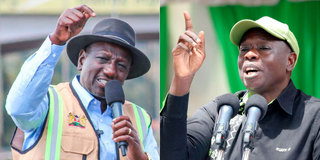
In August 2022, President William Ruto and his running mate Deputy President Rigathi Gachagua won a famous victory in the presidential election.
However, they fell out acrimoniously, and in October 2024, President Ruto fed Gachagua to the crocodiles, and the Senate impeached him, the first vice/deputy president to suffer such a fate. The two men are bitter enemies today.
In Ol Kalou, Ruto's ruling United Democratic Alliance (UDA) fielded Samuel Nyaga, and President Ruto invested heavily in his fortunes. At the same time, Gachagua's newly established Democracy for Citizens Party (DCP) backed Sammy Ngotho.
Voters queue to cast their votes at AC Ol Kalou Primary School polling station during the Ol Kalou by-election on July 16, 2026.
Photo credit: Boniface Mwangi | Nation Media Group
DCP's Ngotho swept 85.8 per cent of the vote, while Ruto's man Nyagah scraped just 13.2 per cent. Some people have been quick to declare President Ruto's goose cooked, which would be the case if the political climate in that single Ol Kalou seat reflected the nation in microcosm.
Kenyan regional voting patterns tend to be too particular, but the Mt Kenya region nevertheless stands out for various reasons. Mt Kenya is the second-largest voter pot in the country.
With approximately 5.3 million registered voters, it represents about 21.5 per cent of the national total. But that is still only the second-largest voter pot, after President Ruto's Rift Valley with approximately 5.9 million registered voters, 23.8 per cent of the national total. The Lake Region isn't too far behind with 5.2 million (21.1 per cent).
What Mt Kenya has got is Kenya's most disciplined voters. They turn out in record numbers, and tend to vote as a block. Additionally, it is more homogeneous than the Rift Valley, making it the most lethal single voter bloc.
The risk to President Ruto from a Mt Kenya blowout at this point is still not a certain loss in 2027, but a failure to get the required over 50 per cent on the first round, to avoid a run-off. On present form, even if he fell below 50 per cent, he's still likely the candidate to cross the finishing line first, unless the Opposition throws up a fantastically charismatic figure with national traction to take him on.
Ruto also doesn't need a majority in Mt Kenya to ultimately win a general election if he maintains a decent 30-40 per cent share alongside his strongholds in the Rift Valley and new political arrangements and alliances across Western-Nyanza (Lake), and Coastal regions. But there is something about Kenyan (and developing-country) politics that he, or any other incumbent, can use to turn his fortunes around in 12 months dramatically.
In the UK or France today, you can't get many votes by building hospitals or roads. In some of these countries, hospitals are closing because they don't have patients.
But in African nations like Kenya, it is a big deal. Now Mt Kenya's electorate is heavily driven by economic interests, particularly agriculture (tea, coffee, dairy, macadamia, and avocado farming).
If the Ruto government successfully stabilises crop prices, lowers input costs, and completes major infrastructure projects (e.g., the high-profile Mau Road project, a 540-kilometre highway network under construction across four Mt Kenya counties, hospital upgrades, and markets), voter sentiment can change quickly and favourably.
Ol Kalou stung, but there's still time on the clock for President Ruto. However, he shouldn't sleep too deeply either.
The author is a journalist, writer and curator of the Wall of Great Africans. X@cobbo