Kenya has kicked off a search for a trading name for its crude oil from South Lokichar as the country prepares to export the commodity whose grade is considered cheaper to refine and cleaner.
The Ministry of Energy and Petroleum on Friday gave Kenyans up to October 29 to submit proposals on the trading name of the crude oil whose commercial production is set to start on December 1, 2026.
Kenya will ride on the name to market its crude oil, which is described as light sweet (low sulphur levels), making it cheaper and cleaner for use in producing gasoline (petrol) diesel and jet fuel.
Currently, there is no international law compelling countries to assign trading names for their crude oil. However, a name is critical for market and brand recognition of the crude, allowing traders to tap it and price premium products.
Murban crude is the name of oil from the United Arab Emirates (UAE), West Texas Intermediate (WTI) is from the USA, while Russia uses two trading names for its crude; Urals and Eastern Siberia–Pacific Ocean (ESPO).
Gulf Energy, the company licensed to produce crude oil in Block T6 and Block T7 in South Lokichar, targets to start drilling on November 1, 2026 with the first crude set to be produced from December 1.
“Kenya’s chosen crude name will be the country’s commercial identity in the global oil market for decades and it will carry Kenya’s story to buyers globally. The government therefore considers it right that Kenyans take part in choosing this name,” the Ministry said in a notice on Friday.
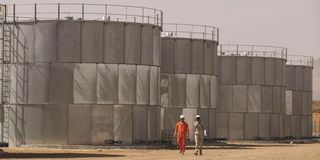
Tullow Oil facility at Ngamia 8 in Lokichar, Turkana County, on February 18, 2020.
Photo credit: File | Nation Media Group
The Ministry says that the name should be available for registration as a trademark in Kenya and internationally.
The crude oil from South Lokichar was first exported to test its global appeal between 2019 and 2020. The samples are said to have earned discounts on the Brent crude, which is from the United Kingdom.
Density and Sulphur content are key metrics that determine the appeal of crude oil to refineries and traders in the global energy markets.
The Turkana crude is highly waxy, meaning that it must be transported in heated pipelines or trucks to keep it at desirable temperatures, potentially pushing up logistical costs and ultimately the cost of the commodity.
Uganda recently named its crude Pearl Sweet, with Kampala saying the name represents its status as the Pearl of Africa while sweet stands for the low Sulphur (sweet) nature of the crude.
Nigeria refers to its crude oil as Bonny Light, while Brent Crude refers to oil produced in oilfields located between the United Kingdom and Norway.
Kenya’s crude oil is set to fight for a market currently dominated by Brent, WTI and Murban, with the trio key in setting prices of the commodity and refined fuel.
Gulf Energy says that it targets producing 20,000 barrels per day (bpd) of crude oil in the first phase of the project (2026-2032) before increasing this to 50,000bpd in the next phase that starts from 2033.