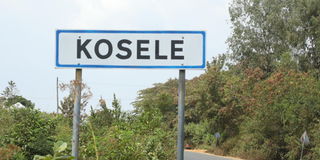
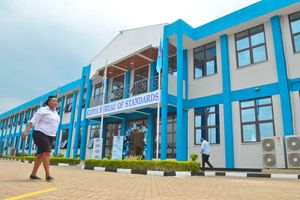
The abandoned Rachuonyo County Council offices in Kosele, Homa Bay County, resemble a scene from a post-apocalyptic film.
Mould creeps across the walls, the roof has rusted after years of exposure to rain, sun and dusty windows stare over a deserted compound where grass now grows through cracked concrete.
The council chambers that once hosted heated debates on budgets, revenue collection, planning and service delivery have fallen silent.
The faded signboard still bears the council's mission: "To deliver quality services to the community efficiently and effectively through a participatory approach." Today, the words stand as a reminder of a bygone era.
The building that hosted the defunct Rachuonyo County Council office in Kosele in Homa Bay County on July 19, 2026.
Photo credit: George Odwuor | Nation
The council was dissolved in 2013 following the introduction of devolution and the creation of Homa Bay County. As county government offices gradually shifted 10 kilometres away to Oyugis, Kosele's fortunes began to fade.
More than a decade later, the once-busy administrative centre has become a shadow of its former self.
A plaque at the building that hosted the defunct Rachuonyo County Council office in Kosele in Homa Bay County on July 19, 2026.
Photo credit: George Odwuor | Nation
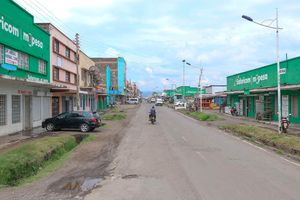
Businesses have closed, traders have relocated, and the streets are noticeably quieter. On Saturdays, the town almost comes to a standstill as the predominantly Seventh Day Adventist (SDA)community observes the Sabbath.
Only a handful of grocery stalls remain open before business resumes gradually on Sunday and Monday.
Residents say the decline began when government services moved to Oyugis, depriving Kosele of the steady flow of people who once sustained its economy.
A plaque at the building that hosted the defunct Rachuonyo County Council office in Kosele in Homa Bay County on July 19, 2026.
Photo credit: George Odwuor | Nation
Before devolution, Kosele was the headquarters of the former Rachuonyo District, serving residents from present-day Karachuonyo, Kasipul and Kabondo Kasipul. People travelled from as far as the Homa Bay-Kericho border to seek government services, boosting hotels, shops, transport and other businesses.
Kendu Bay became the headquarters of Rachuonyo North, Rambula served Rachuonyo East, while Kosele remained the headquarters of Rachuonyo South.
However, its location at the edge of the sub-county made it less accessible than centrally located Oyugis, where county offices were eventually concentrated.
Some of the shops in Kosele in Rachuonyo South in Homa Bay County on July 19, 2026.
Photo credit: George Odwuor | Nation
For businessman Masoud Omollo, the shift transformed his family's fortunes.
“We operated a food kiosk that served travellers seeking government services and also ran a successful retail shop. Business was good because people came here from all over the region,”he says.
He also sold construction sand, another thriving venture, while Kosele remained the administrative hub.
“Everything changed after 2013. Businesses followed the people and the people followed the government offices to Oyugis. We eventually relocated because staying in Kosele was no longer viable," he says.
Office of the Rachuonyo South Deputy County Commissioner in Kosele in Homa Bay County on July 19, 2026.
Photo credit: George Odwuor | Nation
Today, Oyugis has become one of the fastest-growing towns in Homa Bay County.
Its strategic location along routes linking Kisumu, Kisii and Homa Bay has attracted businesses, public investment and transport operators. Travellers heading towards Tanzania and Uganda regularly pass through the town, creating a vibrant commercial centre.
Government investment has accelerated the transformation. Oyugis now boasts a dual carriageway, a modern market and a bus park that continue to attract traders and investors.
Kosele, meanwhile, continues to lose ground.
Even Gulf FM, a Dholuo-language radio station established in 2011, has witnessed the shift.
“Today, almost all our commercial advertisers are based in Oyugis and Kendu Bay. From Kosele, people mainly come to announce missing persons,” he says.
One of the commercial buildings in Kosele in Rachuonyo South in Homa Bay County on July 19, 2026.
Photo credit: George Odwuor | Nation
Important documents still lie scattered inside some offices, slowly being destroyed by termites and dampness.
The building's foundation stone was laid on June 22, 2000, by former council chairman Shem Kisero Mitoko before it was officially opened a year later by then Assistant Minister for Local Government Musa Sirma.
Barely 12 years later, devolution rendered the facility largely redundant.
Today, its gate hangs loosely on broken hinges while abandoned government vehicles sit stripped of tyres and other parts.
Across the fence, however, the Office of the Deputy County Commissioner remains operational alongside the Lands Registry, Civil Registration Department and an office used by the Independent Electoral and Boundaries Commission during elections.
Kosele Stadium in Rachuonyo South in Homa Bay County on July 19, 2026.
Photo credit: George Odwuor | Nation
The contrast is striking. National government offices continue operating, albeit on a smaller scale, while county government services disappeared almost entirely.
Rachuonyo South Sub-County Police Commander Philemon Saera says operating from Oyugis makes more sense.
“Oyugis is centrally located compared to Kosele. It enables us to serve more people efficiently,” he says.
He adds that office space and government housing in Kosele have deteriorated, forcing many officers to live in Oyugis and commute.
Although security meetings are still held at the Deputy County Commissioner's office in Kosele, Mr Saera says service delivery has not been affected.
‘There is no vacuum. We continue serving residents seamlessly despite operating from different locations,” he says.
The late Kasipul MP Ong'ondo Were had proposed relocating all government services officially to Oyugis after recognising its rapid growth, but he died before the plan materialised.
Current Kasipul MP Boyd Were did not respond to calls or text messages seeking comment on plans to revive Kosele.
According to Masoud Omollo, Kosele lost momentum when the courts were moved to Oyugis in the early 1980s.
Some residents attribute the relocation to stories that the old court was haunted, although others dismiss the claims as mere folklore.
David Ouma says whatever the reason, Kosele has continued falling behind while neighbouring towns prosper.
“Without government staff or services, the administrative headquarters exists only on paper. Businesses cannot grow and young people have few opportunities,” he says.
Office of the Rachuonyo South Deputy County Commissioner in Kosele in Homa Bay County on July 19, 2026.
Photo credit: George Odwuor | Nation
Samson Otieno says land had been set aside for a Kenya Medical Training College that could have stimulated the local economy, but the institution was instead established at Rachuonyo South Sub-County Hospital in Oyugis.
He believes successive leaders have used Kosele's development as a campaign promise without delivering meaningful projects.
“We were hoping the college would transform Kosele. That land still lies idle. It is difficult to understand why county offices were built elsewhere while existing government buildings here were abandoned," he says.
Trader Bob Talo says renovating the old county council offices would have been more economical than constructing new offices in Oyugis.
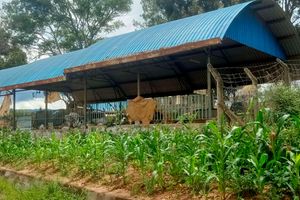
A boda boda shed in Kosele in Rachuonyo South in Homa Bay County on July 19, 2026.
Photo credit: George Odwuor | Nation
Resident Michael Aroko says the town can only recover if the local market is modernised and positioned closer to the main road to attract passing motorists.
“That is how towns such as Oyugis have grown,” he says.
Today, the only notable county facilities associated with Kosele are a health centre which lies across the administrative boundary in Rachuonyo North and a neglected stadium.
The pavilion roof has been blown away, steel bars have been stripped from the terraces by scrap metal dealers and goats now graze where school competitions once drew large crowds.
“We used to host school games here .Today, only livestock use the field,” says Mr Aroko.