Mr David Macharia has spent decades coaxing potatoes from the fertile soils of Mau Narok. Yet he says the biggest share of the harvest goes to people who never lift a hoe.
On a calm morning at his home near Mau Narok trading centre in Njoro Constituency, the farmer adjusts his spectacles, welcomes the Daily Nation onto his veranda and serves a breakfast of mashed potatoes, beans and eggs.
Then, dressed in a faded shirt, soil-dusted trousers and gumboots, he leads us into “Kwa Macharia”, his five-acre farm, where the crop stands lush and green.
For decades, his name has been synonymous with potato farming in the area, since he quit pyrethrum many years ago. But like thousands of other potato farmers in the South Rift, he is a troubled man.
“We have really suffered in the hands of middlemen. These people don’t plant, don’t weed, don’t suffer the cold and the rain, yet they eat the biggest share while the farmer is left with very little. We are being milked dry by middlemen who have turned farming into a cartel business,” he says.
Across Nakuru, Nyandarua, Bomet, Narok and Kericho, farmers say they are squeezed by cartels, poor prices driven by the flouting of packaging rules, lack of storage and value addition, and bad roads. They break their backs on the land, they say, while brokers walk away with the profits.
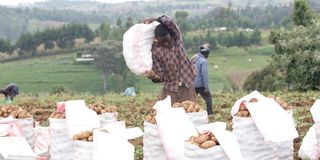
At the heart of the grievance is the sack. A kilometre from Mr Macharia’s farm, John Maina inspects his four-acre field and explains how brokers force farmers to pack potatoes in 90-110kg bags, then sell them by the kilogramme in retail markets.
The Daily Nation established that such oversized bags sell at between Sh5,000 and Sh6,500 in Nairobi, Mombasa and other major towns. The practice is popularly known as “dusura”.
“Without these people you cannot access the market. They have tentacles spreading as far away as Nairobi, Mombasa, Busia and other key towns. They get a large percentage of potato sales,” says Mr Maina.
Farmers who insist on 50kg packs, he says, are punished with poor prices “because the cartels rule the market”. Yet a 90kg sack fetches roughly the same as a 50kg one, and after harvesting and loading charges of Sh100 and Sh50 respectively, the farmer ends up making a loss.
Ms Jane Moraa, a farmer from Molo, says her lorry was turned away when she tried to bring her produce to Molo Market. “These brokers do not like newcomers into the market, so they sent me back and I had to go through them,” she says.
A spot check at markets across the South Rift, including Nakuru’s Wakulima Market, showed that brokers call the shots. They dictate prices to buyers, among them restaurants and small-scale traders, on a take-it-or-leave-it basis, and most buyers take it because they have no alternative.
On paper, the law is on the farmers’ side. The Irish Potato Regulations 2019 require packaging in standard bags of not more than 50kg and the use of approved weighing scales.
A farmer harvests potatoes in Ndimu Farm, Elburgon in Nakuru County on July 30, 2025.
Photo credit: John Njoroge | Nation Media Group
Offenders risk a year in jail or a fine of up to Sh500,000, and inspectors can seize and detain non-compliant consignments at the offender’s cost. In practice, inconsistent or absent enforcement in the counties has left the rules toothless, whatever local governments say. The 50kg pack remains largely a myth.
“I have been planting potatoes in my 5-acre farm for the past two years. Without these brokers, I could have been a millionaire, but they control the market and pricing. You can’t sell your produce without them,” says Mr Kariuki.
The arithmetic explains the anger. A farmer in Nakuru or Nyandarua should net between Sh145,000 and Sh440,000 per acre per season, depending on seed variety, yield and market prices. Super Shangi growers harvest 80 to 100 standard 50kg bags per acre, which should bring revenue of Sh200,000 to Sh320,000 and net profits averaging Sh150,000 to Sh200,000.
Much of that money, farmers say, ends up with brokers, who resell the produce at a hefty profit. Costs bite too. Seed for one acre costs Sh24,000, and some farmers say they still end up in the red.
“The cost of production is very high. We are seeking intervention from the county and national government so that farmers get better returns. Sometimes farmers do not have access to certified seeds to boost potato yields,” says Ms Mary Nyanchera of Molo.
The stakes are high because the South Rift is Kenya’s potato heartland. Nakuru produces at least 600,000 tonnes annually, about 20 per cent of national output, according to the National Potato Council. In 2023, it produced 657,091 tonnes, beating Nyandarua’s 437,748 tonnes. The crop thrives in Molo, Subukia, Kuresoi South and North, Mau Narok and Njoro.
Nyandarua earns an estimated Sh9 billion a year from potatoes, and county records show it produces between 550,000 and 600,000 tonnes from about 37,000 hectares.
Nationally, Kenya produced 2.2 million tonnes of potatoes worth Sh72.5 billion in 2024, down from 2.3 million tonnes in 2023, according to the Kenya National Bureau of Statistics’ National Agriculture Production Report 2025. Failed short rains and excessive long rains fuelled fungal diseases, including blight.
More than 800,000 farmers grow the crop, and the government wants to raise output to six million tonnes by increasing the number of farmers to 1.5 million. Consumers are paying for the shortfall. By November last year, a kilo of potatoes cost between Sh27 and Sh50, depending on the county.
This year, prices go as high as Sh79. Kajiado had last year’s lowest price at Sh27, while Isiolo and Meru, a potato-growing county, now pay the highest, at Sh79 and Sh61 respectively.
The National Potato Council attributes the higher prices to unreliable weather. Between February and May, heavy rains caused crop failure of up to 80 per cent in most growing counties.
“The rains came unexpectedly too early in the year, lasting until May, when potatoes planted in February were ready to harvest. We planted an acre of clean potato seed, expecting to harvest more than 120 bags, which we did achieve, but more than half the produce was destroyed by the excessive rains,” says Mr Joseph Mwaura.
In Kinangop, farmers recorded total crop failure, says Nyandarua Potato Growers Association chairman Mr Chege Kahuni. “The rains were very heavy, coming at an unexpected time of the year. Most farmers lost their entire crop. That is why the prices at the market did not reduce this year.”
Prices are unlikely to stabilise soon because of climate change and limited access to quality seed. Nyandarua County Executive for Agriculture Francis Miring’u says the county is embracing conservation agriculture and climate-friendly potato varieties.
“The county government is partnering with farmer groups in growing and multiplying clean planting materials,” he says.
Seed-borne and soil-borne pests and diseases, along with soil infertility from years of continuous planting, are the main drivers of declining yields. Uncertified seed and poor agronomic practices have also fuelled outbreaks in the potato belts.
Labourers pack potatoes into 110-kilogram sacks at Geta Forest in Nyandarua County, on October 23, 2026.
Photo credit: Boniface Mwangi | Nation Media Group
Dr Kibet Sitienei, Bomet County Chief Officer for Agriculture and Livestock Production, lists early blight (Alternaria solani), late blight (Phytophthora infestans), bacterial wilt (Ralstonia solanacearum), common scab (Streptomyces spp) and blackleg among the diseases causing losses. Early blight, he says, shows as small dark spots on leaves and leads to defoliation. It is treated with fungicides, and farmers are advised to rotate crops.
The Kenya Agricultural and Livestock Research Organisation (KALRO) does its potato research at the Horticulture Research Centre in Tigoni, Kiambu County, and replicates it at breeding centres elsewhere. It has partnered with the International Potato Centre, the African Agricultural Technology Foundation and the National Biosafety Authority to develop a genetically modified potato resistant to pests and diseases.
“Pests and diseases remain the biggest challenge to potato farmers and a hurdle to high productivity. KALRO has partnered with institutions, organisations and farmers on research with a view to addressing the challenges,” says KALRO Director General Dr Patrick Ketiem.
Agriculture Cabinet Secretary Mutahi Kagwe outlined the plans at the opening of the 13th World Potato Congress in Nakuru this year, the first such global event in sub-Saharan Africa, which drew more than 600 participants from 67 countries. He said the country was seeking partnerships to raise production, improve access to quality seed, strengthen storage and expand markets for farmers.
The GM variety, he said, carries three resistance genes inserted into the Shangi variety, and a few trials have shown complete resistance to late blight, which would cut out fungicide sprays and lower production costs.
Mr Kagwe also cited Clone IG-70, a drought- and blight-tolerant variety developed at KALRO’s Tigoni centre, which is progressing towards final verification.
“Supplying proper quality seeds is part of the government’s ambition as we make the industry important. We are scaling up potato technology by distributing varieties to help small-scale farmers overcome quality seed shortages,” he said.
The National Potato Council of Kenya and the Agricultural Development Corporation are also key to seed multiplication. Nakuru, Narok, Nyandarua, Meru, Kirinyaga, Nyeri, Taita Taveta, Bungoma, Elgeyo Marakwet, Trans Nzoia, Uasin Gishu and West Pokot are the leading seed production counties.
Mr Kagwe urged investors to expand potato processing and replace imported potato products with locally made ones.
That is the idea behind Sereni Fries, a local company making ready-to-cook products for hotels and restaurants, saving them the time they spend peeling, cutting and processing tubers. Its founder, Mr Humphrey Mburu, saw a chance to cut that preparation work for an expanding market.
Mr Mburu sources potatoes directly from smallholder and medium-scale farmers and turns them into fresh-cut, precooked and frozen products for businesses and households across Kenya.
He sees great potential as the fast-food industry expands and demand for standardised ingredients grows. Much of the frozen fries used by large food-service businesses is imported.
“Besides South Africa and Egypt, there are few frozen potato processing factories in Africa. Many fast-food franchise restaurants operating in Kenya import potatoes from countries such as the Netherlands and Egypt. We saw an opportunity for locally produced frozen chips,” he says.
Reporting by Mercy Koskei, Margaret Maina, Waikwa Maina, Eric Matara and Vitalis Kimutai