For generations, the vast grazing lands of Turkana’s South Lokichar Basin have been home to pastoral families who have raised livestock, established settlements and buried their loved ones there.
But as commercial oil production approaches, some of these communities are preparing to surrender the land they have called home, amid questions over compensation and where they will go next.
With the government targeting December 1, 2026, for the first commercial oil production, the pressure to complete compensation for project-affected households is mounting.
The exercise is expected to be concluded within the next two weeks, even as questions persist over the valuation of property, the rights of communities whose land is held collectively and the impact of displacement on pastoral livelihoods.
The urgency has intensified following the commencement of drilling by Gulf Energy at the Amosing-1 well pad on Friday, marking a new phase in the South Lokichar oil project after the company took over from Tullow Oil.
Energy Cabinet Secretary Opiyo Wandayi said the drilling will continue uninterrupted, with the government hoping to have President William Ruto flag off the first trucks transporting crude oil to the Port of Mombasa for export in the first week of December.
“Today is essentially the start or commencement of drilling operations in this place and it will continue non-stop. We are hoping that come the first week of December this year President William Ruto will officially flag off the first trucks carrying away crude oil to the Port of Mombasa for export,” Mr Wandayi said.
But as the oil project gathers pace, the compensation process has exposed a difficult question: will the payments adequately account for what communities stand to lose beyond their houses and other physical structures?
About 3,300 project-affected people are caught up in a compensation exercise that has left questions over the rights of pastoral communities and the future of their livelihoods.
Government says Sh200 million set aside
A joint team from the Department of Lands and Physical Planning, the State Department for Petroleum and the NLC informed Turkana County Commissioner Julius Kavita that the National Treasury had allocated Sh200 million for the initial compensation of affected development structures.
Mr Jacob Kipaa, from the NLC's Directorate of Valuation and Taxation, said the team was engaging affected communities and issuing compensation awards after verifying the documentation required for payment.
“The engagements were aimed at ensuring PAPs are adequately informed and that the compensation process is undertaken in a transparent, orderly and participatory manner,” Mr Kipaa said.
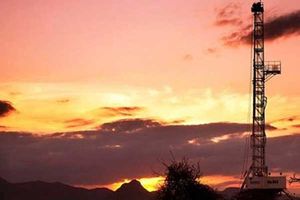
The GW-70 drilling rig that has began drilling crude oil at Amosing well site in Turkana County's South Lokichar Basin.
Photo credit: Sammy Lutta | Nation Media Group
Mr Kavita urged the team to uphold due diligence, transparency and proper verification throughout the exercise, assuring it of the necessary support.
With drilling now under way and the first commercial oil production target approaching, the Government faces pressure to conclude the compensation process without overlooking the concerns of the communities whose land and livelihoods are at stake.
Two weeks to complete compensation
Gulf Energy Country Manager Franklin Juma said last week that a multi-agency team comprising the National Land Commission (NLC), the Ministry of Lands and the State Department for Petroleum was overseeing the final stages of compensation.
He said the National Treasury had been informed to release funds to enable the NLC to issue award letters to eligible beneficiaries, with the process expected to be concluded within the next two weeks.
“Areas of Lopii and Lokwamosing are already receiving money,” Mr Juma said.
He put the number of project-affected persons at 3,300, although about 1,300 could not be traced.
Mr Juma said compensation would be channelled through Community Land Management Committees (CLMCs), as provided for under the Community Land Act.
The Nakukulas Economic Development Organisation, a grassroots community and advocacy organisation that works on community land rights, natural resource governance and local participation in oil and gas activities in Turkana, confirmed that compensation was under way in several villages.
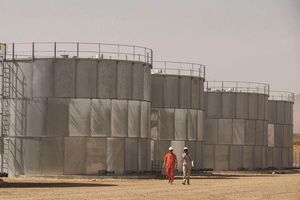
Specialized expatriates at Amosing well site in Turkana’s South Lokichar oil operations.
Photo credit: Sammy Lutta | Nation Media Group
Its secretary, Mr James Namuron, who has been following the exercise, said the team was expected to visit Kodekode village. He said some project-affected people were receiving between Sh1.5 million and Sh2.8 million, depending on the type of houses they had built.
He identified about nine affected villages, including Ng'Ilimoaikemer, near the Amosing well site, Lokosmekori and Lotiman.
Mr Namuron said residents with grievances were being given an opportunity to present them to officials conducting the exercise.
However, the amounts being paid vary considerably depending on the structures and improvements identified during the valuation.
“There are people getting between Sh1,500 to Sh5,000, for not having a structure to show ownership or where there are dry livestock excretes,” he said.
He said some owners of manyatta houses were receiving between Sh120,000 and Sh150,000, while he had witnessed the owner of a two-roomed mud-walled house receive about Sh900,000.
The variations have brought into focus the criteria used to assess property and determine what individual households should receive.
Where will displaced herders go?
Beyond the value attached to houses and other structures, the impending displacement threatens to disrupt the pastoral way of life in communities where access to grazing land, water and established livestock routes is essential to survival.
Mr Namuron said some families had established permanent settlements in strategic locations partly to protect their livestock from frequent attacks by armed bandits.
Their relocation could force them back into areas they had abandoned years ago because of insecurity.
He cited Kakong'u, Katamanak and Lochakula, as well as hilly grazing areas, as some of the places herders might have to consider despite the security risks.
The GW-70 drilling rig that has began drilling crude oil at Amosing well site in Turkana County's South Lokichar Basin.
Photo credit: Sammy Lutta | Nation Media Group
“Those who have livestock will suffer as they will have to go to the most insecure areas where they abandoned many years ago due to insecurity. Frequently attacked Kakong'u, Katamanak, Lochakula or the hilly grazing fields will be the riskiest options for herders,” Mr Namuron said.
For pastoral households, the loss of land is not simply about giving up a homestead. It can mean losing access to grazing areas, water points, livestock routes and the networks through which families share resources during drought.
These concerns have raised questions about whether the compensation framework captures the wider social and economic value of community land, particularly where individual structures are being assessed separately from the land on which they stand.
Rights of the wider community under scrutiny
Friends of Lake Turkana (FoLT), which works with indigenous communities across the Greater Turkana Basin to protect the lake, defend land and human rights, and promote community-led development, has questioned whether the process adequately recognises collective land rights.
The organisation argues that compensation cannot be considered just if it focuses on improvements made by individuals while leaving the underlying community interest in the land unclear or unaccounted for.
FoLT founder Dr Ikal Ang'elei said oil development was taking place in an established pastoral landscape whose productive capacity had been built and sustained over generations through infrastructure, ecological relationships and social arrangements.
She questioned how the interests of people who depend on the same territory through mobility, shared grazing, water access, drought reserves and reciprocal access arrangements were being protected.
“The central question remains: if the NLC is paying individuals for improvements on community land, where is the award that values and compensates the community’s underlying interest in the land itself? And how are the rights of all other users - those who depend on the territory through mobility, water, grazing, drought reserves and reciprocal access being protected?” Dr Ang'elei said.
She warned that paying an individual for a house or other improvement should not be treated as settling the value of the underlying community land or the rights of other people who rely on it.
The concern raises a fundamental issue for the compensation exercise: how will the process account for people who may not own a permanent structure but depend on the land for grazing, access to water and other shared resources?
For pastoral communities, land is not merely a physical asset. Its value is also tied to mobility, access to seasonal grazing areas and the ability to move livestock in response to changing weather and pasture conditions.