Noah Simiyu had just left work on February 17, this year and was riding his motorcycle home when two men and a woman tried to flag him down in the Daraja Guywa area of Bungoma County.
Simiyu stopped, and one man requested a ride, but he declined, explaining the motorcycle was not for commercial purposes.
Moments later, the trio turned violent. The woman and one of the men pulled out a machete, dragged him off the bike and fled towards the Uganda border.
Bleeding, Simiyu used the Mogo application to contact financier’s emergency recovery team before reporting the attack to police.
Working with officers, the recovery team tracked the motorcycle and found it abandoned in bushes at Lwakhakha near the Kenya-Uganda border two hours later.
Investigators discovered the thieves had already removed two trackers, replaced the battery and cut off the mud flaps, suggesting the gang knew how to disable tracking systems before smuggling the motorcycle across the border.
The attempted escape route mirrors growing fears among security officers that stolen motorcycles are quickly smuggled through unofficial crossing points commonly known as “panya routes” before they can be traced.
In another incident on January 26, a motorcycle stolen in Nandi Hills was recovered in Kisumu hours before investigators believe it would have been transported towards Uganda.
The motorcycle belonged to John Bitok, who had entrusted it to a rider operating it commercially.
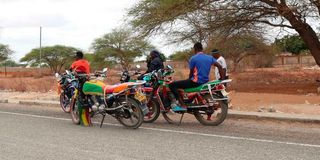
Boda boda riders protest in Kisumu on August 25, 2025.
Photo credit: Alex Odhiambo | Nation Media Group
Around 2am, thieves broke into the rider’s rental compound and cut through a padlock before escaping with the bike. Fortunately, the tracker remained active.
Bitok immediately alerted Mogo’s emergency response team before reporting the theft at Nandi Hills Police Station.
Together with police officers, recovery teams traced the motorcycle to a car wash in Kisumu by 7am the following morning.
Investigators believe the bike was likely waiting to be transferred through Busia and eventually into Uganda before the operation was disrupted.
Security agencies now say such thefts are increasingly being carried out by organised relay networks where one group steals motorcycles, another transports them and separate handlers oversee resale or dismantling across borders.
The crisis is equally severe in northern Kenya where motorcycles stolen from other parts of the country are believed to be taken towards border counties before disappearing into neighbouring states.
For thousands of bodaboda riders across Kenya, a motorcycle is more than a means of transport. It is a livelihood, a family’s source of income, and often the only asset standing between survival and poverty.
But a growing wave of violent motorcycle thefts is now exposing the deadly operations of organised criminal syndicates moving stolen bikes across Kenya’s borders into neighbouring countries where they are resold, dismantled for spare parts or given entirely new identities.
Security agencies in Kenya and Uganda now believe the crimes are no longer isolated robberies but a sophisticated cross-border criminal enterprise stretching from western Kenya to the northern frontier of Ethiopia.
In April, a joint Kenya-Uganda security meeting was held at the Suam border in Endebess, Trans Nzoia County where security officers, boda boda leaders and motorcycle financiers from both countries agreed to establish a joint committee to tackle the rising cases of cross-border theft and intelligence sharing.
The forum, organised by Mogo, a motorcycle financier which operates in both countries in partnership with Boda Boda Safety Association of Kenya (BAK), aimed to address a growing threat that is depriving hundreds of riders of their livelihoods.
Participants at the meeting revealed that suspects routinely switch number plates between Kenya and Uganda immediately after crossing the border while others tamper with chassis numbers to make tracing difficult. Authorities also identified unlicensed scrap metal dealers as part of the illegal network, accusing them of buying dismantled motorcycle parts from stolen bikes.
At a stakeholders’ meeting in Maralal, Samburu County on May 15, security officers warned boda boda operators against purchasing second-hand motorcycles without ownership documents, saying many stolen bikes were ending up in the region.
Authorities said some motorcycles are sold cheaply to unsuspecting residents while others are smuggled further into neighbouring countries where they are dismantled and sold as spare parts.
Samburu Central Deputy Sub-County Police Commander Zachaeus Ochieng warned that some of the thefts involve brutal violence against riders.
“Some victims are seriously injured or even killed before their motorcycles are stolen and sold,” he said during the meeting.
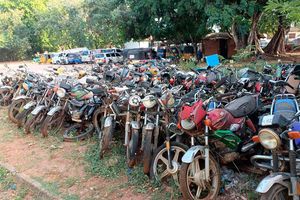
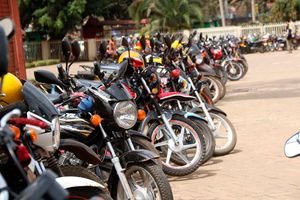
Motorcycles parked at Nyayo Stadium, Nairobi on July 25, 2022. Motorcycle theft in Kenya has quietly evolved from an opportunistic street crime into a sophisticated enterprise
Photo credit: LUCY WANJIRU| NATION MEDIA GROUP
One Samburu rider knows that danger all too well. After years of saving through a local savings scheme, he raised Sh70,000 and qualified for a loan worth three times that amount to buy a motorcycle.
He travelled to Nairobi, bought and customised a new motorcycle along Ngong Road, then returned to Samburu determined to build a better future through the boda boda business.
Late in 2024, two men approached him claiming they had missed a bus to Kisima and needed transport. Along the journey, they casually asked about his family and personal life. But near Kisima, they diverted him off the main road into a deserted path.
One suspect suddenly grabbed the motorcycle keys and declared: “We want this bike.” The rider then saw a dagger while the second man produced a pistol and ordered him to remain silent.
The robbers stole the motorcycle, his phone and money before escaping towards Maralal. One attacker attempted to stab him and repeatedly struck him with the dagger handle before his accomplice intervened.
Before fleeing, the victim overheard the men saying they intended to reach Marsabit before midnight and cross beyond Archer’s Post within hours. He believes the motorcycle was eventually smuggled into Ethiopia through the Moyale border.
Authorities in Samburu warn that stolen motorcycles from Nairobi and other regions are being trafficked northwards through counties such as Marsabit and Turkana before crossing into neighbouring countries.
Ochieng said unsuspecting riders are increasingly falling victim to fraudsters selling stolen motorcycles.
“We have received reports of motorcycles stolen in other parts of Kenya being sold in Samburu with promises that the logbook will be delivered later. In many cases, the sellers disappear after the sale,” he said.
Data shared by Mogo showed that motorcycle theft reports rose steadily over the eight-month period with incidents increasing from 280 in August 2025 to 639 in March, 2026.
A boda-boda rider ferries a woman and a child in Ngara, Nairobi.
Photo credit: Evans Habil | Nation Media Group
Of the total 3457 incidents recorded in the 2025/26 period, cases of theft stood at 1,138 armed robberies stood at 562, organised groups (1,057) and self-theft (700). The report noted that armed attacks on riders are common, with gangs operating across Kenya’s borders with Uganda, Tanzania and Somalia. At least five clients have lost their lives during these cases.
The report also flagged the rising cases of “self-theft”, where some customers allegedly hide motorcycles and falsely report them stolen, as well as cases where proxies are used to acquire motorcycles on behalf of financiers before the bikes disappear. However, the recovery rate of the bikes has steadily increased from 43 per cent in August 2025 to 60 per cent in March, 2026.
Leaders from Uganda also admitted that the problem is affecting communities across the border. During the Suam border meeting in Trans Nzoia, officials disclosed that more than 200 registered motorcycles had been stolen in Uganda’s Sebei sub-region over the past two years, with some suspected to have crossed into Kenya through Kapenguria and Endebess.
Ugandan security officer Ronald Topacho described the thefts as organised crime networks operating across borders rather than ordinary robberies.
“This is not ordinary theft; it is organised crime operating across borders,” he said.
His Kenyan counterpart, Eric Mutua, blamed corruption at border points for helping suspects move stolen motorcycles across countries undetected.