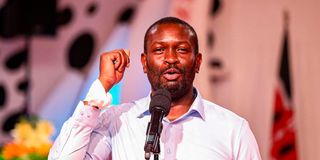
Nairobi Senator Edwin Sifuna’s October 20 meeting with former Deputy President Rigathi Gachagua has opened a new front in the contest to fly the opposition’s presidential ticket, threatening to upset the delicate balance among leaders positioning to challenge President William Ruto in 2027.
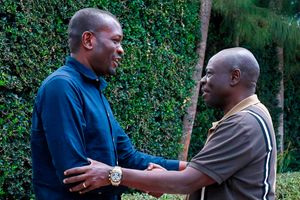
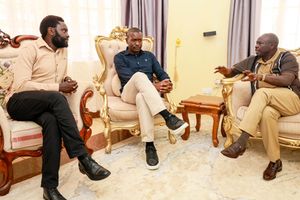
The meeting at Mr Gachagua’s Wamunyoro residence in Nyeri was described by his allies as introductory, but analysts say its political significance extends far beyond the photographs of the former Deputy President welcoming the senator and his Linda Mwananchi team to his home.
It brought together two politicians who once stood on opposite sides of one of the most consequential confrontations of President Ruto’s administration: Mr Gachagua’s impeachment in October 2024, in which Mr Sifuna took part as a senator.
Now, as the opposition struggles to agree on a common candidate for the August 2027 General Election, the two are exploring cooperation that could alter the balance of power among the government’s challengers.
At Wamunyoro, the two camps agreed to pursue a united presidential ticket and support whoever is chosen to lead it, although the selection process remains unresolved. An insider told the Nation to expect a “coalition of the Mountains”, linking Mt Elgon, in Mr Sifuna’s Bungoma County backyard, with Mt Kenya, Mr Gachagua’s stronghold.
Mr Gachagua has publicly said he would deputise Mr Sifuna if the Nairobi senator emerges as the opposition’s strongest candidate. Speaking during his United States tour, he signalled that he was open to different ticket combinations.
“I know Ruto well and I am the person to send him home but if I am unsuccessful and they persuade me otherwise, I Riggy G I can deputise Sifuna,” he said.
At Wamunyoro, he reinforced the message: “I wanted us to be together and agree that we are one team and we mean well for the country.” He rejected claims that the partnership was driven by ethnicity, arguing that cooperation should not be constrained by regional identity.
DCP party Leader Rigathi Gachagua met with Linda Mwananchi Party leb by leader Edwin Sifuna at his Wamunyoro residence.
Photo credit: Pool
The remarks, however, do not settle who would lead a joint ticket, and the arrangement carries what is said to be the elephant in the room.
Mr Gachagua has reportedly allowed his strategists to explore floating Nyandarua Senator John Methu as an alternative running mate in talks with Mr Sifuna, should the courts fail to suspend the consequences of his impeachment. Rival ambitions and behind-the-scenes manoeuvres over the ticket and the running mate could fracture the nascent alliance before it takes shape.
“Both men have political ambitions, and the practical question is whether their emerging relationship can accommodate those ambitions without creating another leadership dispute,” argues advocate Chris Omore.
Just months ago, Mr Sifuna was hardly mentioned among likely contenders for the country’s top seat, although his name was increasingly floated as a possible running mate. His growing influence, particularly among the youth, has since pulled him into talk of the opposition’s presidential ticket, buoyed by grassroots support that has seen market women, popularly known as mama mboga, contribute money towards his political ambitions.
He has expressed humility at the gesture, saying he was deeply touched that ordinary women trading in markets would put their hard-earned money behind him. Their contributions, he said, were “a powerful demonstration of public confidence that I cannot take for granted.”
His rise has been fuelled by his break with ODM after months of internal disputes over the party’s cooperation with President Ruto’s United Democratic Alliance and its direction following the death of former Prime Minister Raila Odinga. As ODM secretary-general, he had become one of the most recognisable defenders of the party’s independent identity and a vocal critic of the broad-based arrangement with the President.
The disagreements pushed him towards a separate political vehicle, The Equitable Party, now being rebranded as the Linda Mwananchi Movement.
It seeks to build an identity around constitutionalism, public accountability and an economic agenda focused on ordinary citizens. Its appeal lies partly in the argument that opposition politics should be about more than negotiating positions in a future government.
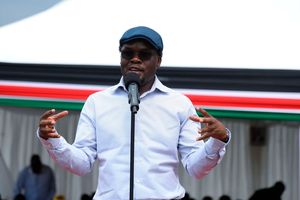
Nairobi Senator and The Equitable Party (TEP) leader Edwin Sifuna during a joint media engagement at Four Points By Sheraton Nairobi Hurlingham on October 9, 2026.
Photo credit: Evans Habil | Nation Media Group
During a joint media engagement with journalists at Four Points by Sheraton Nairobi Hurlingham on October 9, Mr Sifuna defended his Senate record and left open cooperation with leaders he had previously disagreed with.
Asked about working with Mr Gachagua, he said: “I have already impeached him for that. So, you cannot ask me what I think when I have already impeached him for his mistakes.”
The answer separated his constitutional role in Mr Gachagua’s removal from the question of whether the two could work together politically. Mr Sifuna has, however, declined to be drawn into the details of a future coalition.
“Just hold your horses, those conversations will come way down the road,” he told the Nation when asked about his ambitions and the formula for choosing a joint flag-bearer.
Political analyst Geoffrey Mboya says these positions give Mr Sifuna a foundation on which to build a movement beyond the confines of ODM.
“They also place him in a potentially influential negotiating position, as he can appeal to voters dissatisfied with the broad-based government while engaging opposition figures whose political constituencies differ from his own,” Mr Mboya says.
He adds: “His challenge is to convert that visibility into an organisational structure capable of sustaining a national campaign without losing the distinct identity that has attracted his supporters.”
For Mr Gachagua, the engagement broadens the opposition’s reach as Mt Kenya remains central to 2027 calculations. He has built his profile around his fallout with President Ruto and an effort to consolidate voters who feel alienated by the administration. Yet a coalition cannot rely on one region; Mr Sifuna offers access to young voters and others attracted to his criticism of the broad-based government.
The emerging arrangement adds a new variable to an opposition landscape already crowded with presidential ambitions, competing political vehicles and disagreements over who should control the coalition’s negotiating process.
Wiper leader Kalonzo Musyoka (right) and Nairobi Senator Edwin Sifuna during a past rally Nairobi.
Photo credit: Billy Ogada | Nation Media Group
The most immediate pressure may fall on Wiper leader Kalonzo Musyoka and Jubilee presidential candidate Fred Matiang’i, who have sought to place themselves at the centre of coalition-building. Mr Musyoka has been associated with reorganising the former Azimio coalition as The Ukombozi Alliance, meant to unite parties behind one presidential candidate while letting them keep their identities. The coalition has, however, faced questions over its leadership structure and how a flag-bearer would be chosen.
Mr Sifuna’s movement and Mr Gachagua’s DCP have resisted joining the Ukombozi framework, raising the prospect of parallel negotiations.
“If the Sifuna-Gachagua engagement develops into a formal electoral arrangement, Kalonzo may have to negotiate with a bloc that has its own leadership ambitions and regional networks rather than simply draw other principals into his preferred framework,” Mr Omore says.
The question, he adds, is not whether Mr Musyoka remains important but whether his coalition keeps its central role in determining the ticket.
The convergence also complicates calculations for People’s Liberation Party leader Martha Karua, Democratic Party leader Justin Muturi and DAP-K leader Eugene Wamalwa, who have all been involved in efforts to assemble a united opposition.
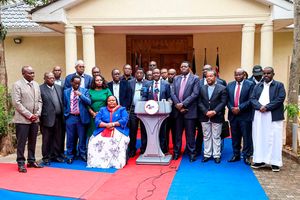
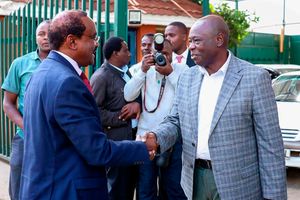
Dr Matiang’i, Ms Karua and Kiharu MP Ndindi Nyoro have meanwhile strengthened their cooperation, appearing together in Njoro, Nakuru County, on October 21 to criticise President Ruto’s economic promises and call for an alternative political direction.
Their show of unity demonstrates that the internal contest is not simply between Mr Sifuna and established party leaders. Mr Musyoka, Mr Wamalwa and Mr Muturi are also building their own relationships and seeking to influence the choice of candidate. At the burial of Mwalimu Jackson Karua in Kirinyaga on October 3, Dr Matiang’i called for consistency among opposition leaders as they negotiated a joint ticket.
Former Machakos Senator Johnson Muthama, now a Parliamentary Service Commission commissioner and an ally of President Ruto, has warned against underestimating Mr Musyoka. He cites the Wiper leader’s service under former President Daniel arap Moi, his appointment as Vice-President by former President Mwai Kibaki and his selection as Mr Odinga’s running mate in 2013 and 2017 as evidence of enduring relevance, arguing that influence is measured not only by current office but by the alliances and constituencies a politician can bring to a coalition.
“Kenyan politics is often driven by immediate calculations, but seasoned politicians understand that elections are won through a combination of numbers, strategy, credibility and relationships,” Mr Muthama said.
He warned both sides of the divide, the government he serves and the opposition: “In my honest opinion as a citizen and without being misconstrued that I am leaning towards any political formation, truth be told that any faction which will underestimate Kalonzo’s political value come next year will be making a suicidal move. Take this to the bank!”