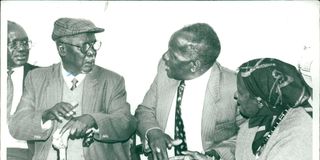
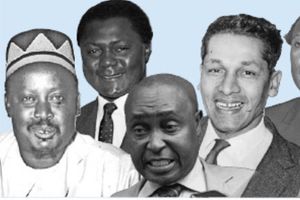
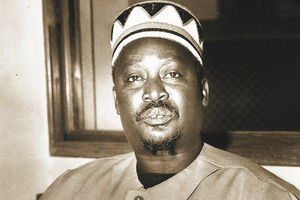
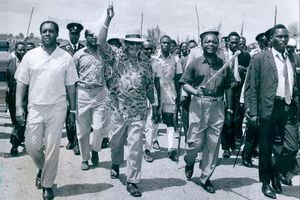
In October 1992, the giant FORD movement, which had given Kanu a waking nightmare, tore itself apart. From its wreckage emerged FORD-Asili under Kenneth Matiba and FORD-Kenya under Jaramogi Oginga Odinga. A movement created to remove President Daniel arap Moi had turned its weapons on itself. The struggle was no longer against Kanu but over who between Matiba and Jaramogi had suffered more, commanded the larger following and was therefore entitled to become Kenya’s next president.
More than three decades later, the opposition is once again walking towards the same dangerous junction. Its leaders agree that President William Ruto should face a united challenge, but remain split over who should carry the presidential flag. Behind the public declarations of unity lie competing ambitions, regional claims, rival political machines and disagreements over when and how the candidate should be selected.
Although the axis led by Rigathi Gachagua, Kalonzo Musyoka, Fred Matiang’i, Martha Karua, Eugene Wamalwa and Justin Muturi and its affiliates profess support for a single opposition candidate, that unity appears conditional on the flag-bearer emerging from within their circle. Watching the contest from outside is Jimi Wanjigi’s Safina Party, which has refused to join the axis and is pursuing an agenda of its own. Like Mwai Kibaki and the Democratic Party in 1992, Wanjigi says he has chosen to anchor his campaign on the economy rather than become entangled in the coalition’s quarrels over personalities, regional numbers and political entitlement.
United Opposition leaders address the media in Nairobi on March 05, 2026.
Photo credit: Dennis Onsongo | Nation Media Group
Currently, opposition supporters are not only mobilised against the incumbent but against rival aspirants within the same coalition. Opinion polls are being used as weapons, while regional numbers are becoming claims of entitlement. It is these numbers that are driving the Gachagua wing of the axis.
There are some lessons that the opposition can learn from FORD politics. First, Moi did not have to destroy FORD; FORD destroyed itself. The danger for today’s opposition is that, in its struggle to find the candidate who can defeat Ruto, it may first create the divisions that guarantee his survival.
When Ford started, the movement looked like a government in waiting. Its rallies drew enormous crowds. Its leaders had been detained, harassed and silenced and its name had become shorthand for the second liberation. The problem was that FORD had mobilised a country before it had built a party. Beneath the famous two-finger salute were unresolved quarrels over leadership, ideology, ethnicity, money and the presidential ticket. Once State House appeared within reach, the glue of resistance dissolved.
The consequences were immediate. The opposition entered the December 1992 election divided among Matiba, Jaramogi and Democratic Party leader Mwai Kibaki. Moi won 1,962,866 votes—about 36 per cent — against Matiba’s 1,404,266, Kibaki’s 1,050,617 and Jaramogi’s 944,197. Kanu retained 100 elected parliamentary seats, while FORD-Asili and FORD-Kenya secured 31 each and the Democratic Party 23.
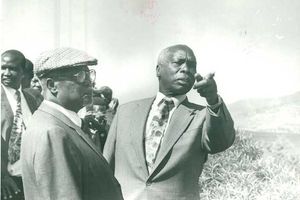
The late President Daniel Arap Moi (right) with Jaramogi Oginga Odinga.
Photo credit: File | Nation Media Group
While the election was deeply flawed, the fragmentation made the incumbent’s work easier in times when the victor did not require a 50 plus one percent vote. A government that had appeared cornered survived because its opponents could not agree on who should lead them.
It was this split that destroyed the momentum of the second liberation. Instead of combining their parliamentary strength, the opposition parties started by quarrelling over who should be recognised as the official leader of the opposition. Moi, even days before the polls, encouraged defections and watched the rival parties weaken one another. What had begun as a national reform movement was reduced to competing personal and regional vehicles. The removal of Kanu was postponed for another decade.
Agip House–Muthithi House moment
More than three decades later, the opposition is again approaching its own Agip House–Muthithi House moment. Its leaders agree that President William Ruto should face a single candidate in 2027. Rigathi Gachagua, impeached and perhaps playing broker’s role, has argued that the flag-bearer can be named as late as May 2027, while Justin Muturi has urged an earlier decision and endorsed Kalonzo Musyoka. Martha Karua has also questioned the proposed selection approach. Other probable contenders within that formation include Fred Matiang’i, Edwin Sifuna and former chief justice David Maraga.
FORD teaches us that coalitions rarely split on polling day. They split earlier, when every camp establishes its headquarters, raises funds and persuades supporters that any other candidate would be an insult.
Former Chief Justice David Maraga (centre), Nairobi Senator Edwin Sifuna (right) and other opposition leaders acknowledge greetings from members of the public during a women empowerment program in Mosocho, Kisii County on July 3, 2026.
Photo credit: Alex Odhiambo | Nation Media Group
That is how the Matiba effect begins: every aspirant accepts the need for unity, but only on condition that the coalition unites behind him or her.
Before the Matiba card was thrown into FORD, they had agreed that Jaramogi would be the ultimate candidate thanks to his long decades of struggle. At the moment, the opposition lacks such a figure after the death of Raila Odinga.
The first lesson from FORD is that rules must come before names. FORD never created a trusted method of choosing its presidential candidate. Its constitution appeared to favour a direct vote of members, but some leaders preferred a delegates’ conference. Each procedure was interpreted as a scheme by one faction to defeat the other. The argument over rules was the presidential contest conducted by other means.
Today’s opposition has not agreed on qualifications, voting body, timetable and dispute-resolution system. Again, there is the thought that sacrifice automatically confers a presidential title deed. Jaramogi, for instance, had spent decades fighting the Jomo Kenyatta and Moi establishments. Matiba had confronted Moi, endured detention and suffered a devastating stroke in custody. Each carried a powerful moral claim. Both camps looked at martyrdom as a qualification.
The present opposition has similar narratives of entitlement. One leader will invoke seniority and years spent waiting. Another will present regional numbers. Another will point to government experience, personal integrity, youth appeal or persecution by the State. While all these are political assets, none creates a right to the ticket.
The third lesson is that crowds in a national coalition can be misleading. When Matiba returned from London in May 1992 to an extraordinary welcome (some people say that the Kanu government had a hand in mobilising people), the crowds misled him and he called for a national poll to pick the ticket bearer. It was on picking the candidate that FORD disintegrated.
It has also been pointed by scholars that while FORD was a successful protest movement, it was incoherent as a political party. Its authority was divided among founding fathers, Young Turks, regional barons and rival secretariats. Its membership register became contested and its headquarters split between Agip House and Muthithi House. Eventually, both factions held parallel elections and claimed to be the original FORD.
The present coalition may face that moment soon which will test the choreographed unity. First, it needs a registered vehicle, common secretariat, county branches, verified membership system, joint agents, lawyers, data teams and coordinated parliamentary and county campaigns. Minus that, candidate might find himself the same awkward position Kibaki found himself within PNU in 2007.
President Ruto might not have to invent opposition divisions. As a veteran of Moi politics, he might widen those already present. A delayed nomination gives the government time to isolate aspirants, cultivate disgruntled allies and negotiate with each faction separately – the same way he has lured the Orange Democratic Movement and split it.
Sixth, there must be a binding covenant for losers. FORD’s problem was not simply choosing between Matiba and Jaramogi. Neither could imagine a dignified political future under the other. In Kenya’s winner-takes-all tradition, losing the nomination appeared to mean surrendering one’s community, career and bargaining power.
The other weakness that was with FORD, and it is the Gachagua-Kalonzo-Matiang’i-Karua axis, is that it was only held together by hostility towards incumbent. Once multiparty politics was restored and elections approached, differences surfaced between radicals and conservatives, old politicians and Young Turks, socialists and liberals. The movement had not adequately answered what it would do with power.
President William Ruto delivers his speech during the Madaraka Day celebrations at Wajir Stadium on June 1, 2025.
Photo credit: Billy Ogada | Nation Media Group
Safina has been asking the question: After Ruto, then what? The Wanjigi argument is that the current opposition should think beyond the ‘wantam’ (one term for President Ruto) slogan and must say what it will do about taxation, public debt, unemployment, corruption, police violence, healthcare, education and the cost of living.
The opposition is currently caught in a dilemma: On the one hand, naming a candidate too early might expose the person to attack and may freeze the coalition before the field settles. On the other hand, naming one too late is equally dangerous. By then, aspirants will have built rival machines and converted personal ambition into community expectation. In such a situation, compromise might look like capitulation.
The final lesson is the hardest: unity requires somebody important to surrender. In 2002, the opposition defeated Kanu after its principal leaders rallied behind Mwai Kibaki. The declaration, led by Raila Odinga, that Kibaki was "tosha" worked because ambition was subordinated, however briefly, to a larger objective. Coalition unity has never meant that all leaders receive what they believe they deserve.
FORD’s history is not an old quarrel. It is a warning. An opposition can command most of the country’s anger and still lose. It can fill stadiums, dominate talk and appear morally superior—yet hand victory to an unpopular government through vanity and mistrust.
Unless today’s opposition learns that lesson, it may again discover that the easiest way to save an incumbent is to assemble all his enemies in one room and ask them to choose a single candidate.