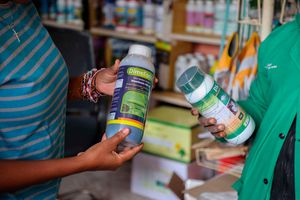
The first response for many farmers facing a pest and disease infestation is to run to agrovets to purchase chemicals to manage the condition of their crops to minimise losses.
This approach can be very effective if the farmer knows the right pesticide, fungicides and herbicides to use. But it can also be dangerous both to the plant and the farmer.
This can happen when the wrong chemical is used and the crops die or produce low yield. Farmers in Homa Bay County admit making this mistake and blame it on lack of information.
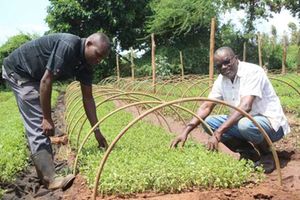
Lolwe Farmers’ Cooperative Society Chairperson Ager Kirowo notes that there is a lot of ignorance among farmers.
“After investing a large sum of money in crop production, a farmer will do anything to ensure his or her crops grow. That is why the agriculture sector is also infiltrated by criminals who take advantage of disparate farmers to sell them what is not recommended,” he says.
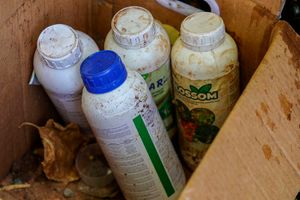
Some farmers have ended up purchasing banned chemicals which are later transferred into the human body when sprayed on crops and the plants are eaten as food.
“Some agricultural extension officers are also not good at what they do. Besides being a few, some are not up to date with changes that are taking place in terms of pest and disease attacks. They therefore leave farmers to fend for themselves but end up making mistakes,” Kirowo says.
Despite these challenges, there is often a broader strategy that modern agriculture emphasizes and can save farmers from unnecessary losses.
Experts encourage farmers to embrace Integrated Pest Management (IPM) which is a more holistic approach beyond immediate chemical intervention to ensure long-term sustainability and reduce reliance on synthetic inputs.
It combines biological, cultural, and chemical methods to manage pests while minimising environmental and health risks.
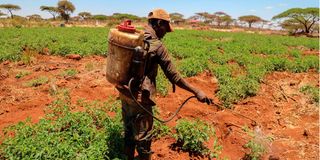
A farmer sprays tomatoes on a farm in Kimana, Kajiado County, on Monday, October 13, 2025.
Photo credit: Dennis Onsongo | Nation Media Group
Experts from Kenya Agricultural and Livestock Research Origination (KALRO) say many farmers purchase pesticides and herbicides without proper diagnosis of pests and disease affecting their crops and often the chemicals fail to work leading to losses.
To ensure this practice is eradicated, the agency has deployed a group of 150 plant health management experts to help farmers control crop pests and disease in five counties.
The agroecologists work in an establishment called plant health clinics where they will have a basic role of helping farmers diagnose disease attacks on their crops. The group also advises farmers on pest management mechanisms.
This is part of a broader plan by the government to ensure food sustainability in the country by increasing food availability.
KALRO trained experts on best farming practices. The team uses their skill to pass the same information to farmers.
Partnerships and business department director at KALRO Margret Makelo says beneficiaries of this programme are in Homa Bay, Nandi, Migori, Bungoma and Kakamega counties.
Each of the regions have 30 experts who can identify multiple pests and diseases affecting crops to help more than 40,000 farmers minimise losses.
She notes that the main role of the experts is to give recommendations after identifying problems that crops have.
"They can help them at the next stage which is management. It can include spraying crops to control fall army worms. The experts can be contacted to spray crops at a small fee," Dr Makelo says.
The initiative is supported by the United Nations Food and Agriculture Organisation (FAO) through a programme called Boost that is funded by the European Union.
When in need of services, a farmer walks to the clinics preferably with samples of crops affected by pests and diseases.
Operators of the clinics then conduct visual inspection of the crops and make reference on a tablet which has a manual on crop pests and diseases including pictures that guide the agroecologists in giving the correct diagnosis.
After giving recommendations, the experts write a prescription sheet which summarises information for the farmer which they can then use to purchase agrochemicals or just follow instructions as directed to save their crops.
All the information issued to farmers in need of help is also kept by KALRO and can be used for future research.
KALRO also deployed its plant health doctors in various regions who can always give advice when the agroecologists are unable to identify problems on crops and give necessary recommendations.
Dr Makelo explains that the agency wants to do away with a tendency of farmers rushing to buy chemicals without first of all knowing what is affecting their crops.
Farmers sprays tomatoes on a farm in Kimana, Kajiado County, on Monday, October 13, 2025.
Photo credit: Dennis Onsongo | Nation Media Group
"Many farmers will be eager to know the chemical they should use, how much it costs and where it can be found without inventing the root cause of the problems. Some pests and diseases do not need chemicals, rather farmers need to know best management practices," the KALRO official notes.
"Pesticide is a last resort. We encourage farmers to engage in good agricultural practices. This includes planting at the right time, with correct spacing and using the right seeds. You will be able to minimise using pesticides and reduce the cost of production," the plant pathologist said.
According to Homa Bay County Agriculture Director Erick Adel, the region has 40 extension officers who are stationed in every ward.
This means that every extension officer serves at least 4,000 farmers.
"Deployment of plant health management experts under the Boost programme will augment what our officers were doing on the ground," Mr Adel says.
Farming experts say up to 30 per cent of crops are lost to pests and the loss can be higher in horticultural production.
He tells farmers and the experts to embrace technology where they can use their phones to share pictures of crops that are affected by pests before farmers are advised on the next course of action.
"The service providers are critical in ensuring we are food secure. Information is key in ensuring food production,” the agriculture director says.
In Homa Bay, the experts operate in Rachuonyo North and Ndhiwa.
Food and Agriculture Organization post-project coordinator Jimmy Mweri says the initiative gives hope to farmers by reducing post-harvest losses and increasing income to farmers.
“The concept is anchored in a youth-led agroecology service providers hub. It is good for suitability and they are bridging the gap of demand and supply,” he says.
The FAO official notes that some farmers use guesswork to spray their crops without advice from experts.
“This intuitive boosts food security and enhances food safety. We are having a lot of banned agricultural products being used in the county today. The agroecologists have been trained on safe use of pesticides and can give advice on chemicals that have been banned,” Mr Mweri explains.
The FAO official adds that the sustainable practices that farmers will adopt will help in combating the effects of climate change.
Mr Mweri says farmers can learn how to take advantage of low rainfall to promote soil health and improve production.
“We are already seeing the fruits where farmers are seeing results of embracing good agricultural practices. Farmers are transitioning from their conventional farming to agroecology,” he says.