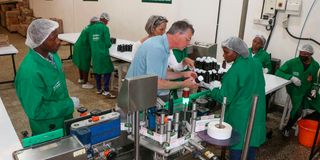
Ian Shaw, Director Kapi Limited inspects with some of his employees liquid organic biopesticides manufactured using pyrethrum at his firm in Nakuru on January 31, 2026.

When Ian Shaw took over KAPI Limited in 2008, the company was a far cry from the agricultural enterprise it is today.
With its roots in Kenya’s historic pyrethrum industry, KAPI was primarily known for household insecticides such as mosquito coils, pyrethrum sticks and insecticidal pet shampoo.
At that time, its connection to agriculture was secondary. Pyrethrum, a flower-based insecticide once closely associated with Kenyan farms, had become increasingly scarce, with many smallholder farmers abandoning the once lucrative crop in favour of a more secure livelihood.
“When we came in, pyrethrum supply was unreliable, farmers were frustrated, and the systems meant to support the industry were failing,” recalls Ian Shaw.
He says their priority was to understand the situation on the ground, what farmers needed, and what the company could actually deliver.
For decades, pyrethrum in Kenya had served as both a natural, fast-degrading insecticide for households and a source of livelihood for smallholder farmers in regions such as the Rift Valley and western Kenya.
However, delayed payments, limited technical support and the collapse of centralised structures such as the Pyrethrum Board of Kenya left farmers disillusioned and many were forced to abandon the crop as it could no longer be relied upon as a stable source of income.
At the same time, synthetic pesticides became widespread. Often cheap and easily available, these chemicals brought new challenges.
“Some synthetic pesticides available on the open market are highly toxic and leave residues on crops for weeks. Some reach farmers through informal channels, creating unnecessary risks for both people and produce,” he explains.
Shaw adds that close interactions with farmers over the past 10 years have made it clear that they need to be able to make informed choices about pesticides.
“This means providing them with safe, biological alternatives and the education to understand the difference. It's about equipping farmers with the tools to farm safely and providing them with the guidance to maximise their effectiveness,” he adds.
KAPI first moved into agriculture in 2014 following the liberalisation of the pyrethrum industry and stabilisation of supply. The company launched Flower DS 4EC, a pyrethrum-based insecticide targeting key crop pests.
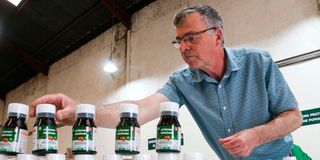
Ian Shaw, Director Kapi Limited displays liquid organic biopesticides manufactured using pyrethrum at his firm in industrial area, Nakuru City on January 31, 2026.
The company later introduced Flower Dust, which provides soil-level pest control.
While these pyrethrum-based products offered a natural alternative to conventional chemicals with minimal residues and very low toxicity, they were only a partial solution.
Pyrethrum is an expensive active ingredient, making the finished biopesticide unaffordable for many smallholder farmers.
Last year, the company added Agripest Organic 75EC and Biopest Plus to its biopesticide portfolio, bringing the total number of products to four. These products are certified organic and are intended for use in zero-residue food production.
These biopesticides are used to control various pests, including Persea mites on avocados, the false codling moth, thrips and Tuta absoluta.
Products with a green colour band are classified as slightly toxic and approved for general use, meaning they can be applied without leaving harmful residues on crops.
In practice, pest control relies on targeted applications.
For instance, Biopest Plus or Agripest Organic 75EC can be sprayed onto leaves to eliminate adult thrips, whereas Flower Dust is applied to the soil at the base of the plant to target pupae.
This approach is intended to disrupt the life cycles of pests and reduce the risk of re-infestation. These products have a pre-harvest interval (PHI) of one day, enabling crops to be harvested shortly after treatment.
Guidance on pesticide use
“Smallholder farmers often cannot wait weeks after spraying. A short PHI enables them to protect their crops and harvest the following day,” he explains.
Some farmers say they are beginning to see practical benefits. Fred Munene, a mixed-crop farmer operating along the border of Murang’a and Kirinyaga counties, says he recently started using KAPI biopesticides because of their short PHI.
According to Mr Munene, being able to harvest crops shortly after application has helped him to increase his sales by around 30 per cent.
“With Agripest, I can spray my crops today and harvest them tomorrow. This flexibility has made a noticeable difference to my sales,” he says.
For others, the educational component is just as important as the products themselves.
Many smallholder farmers learn about pest control through trial and error, or by seeking advice from neighbours or recommendations from agrovet shops.
Formal guidance on pesticide use is often limited, especially in remote areas where government extension services are scarce.
Alongside product sales, the company carries out training activities for farmers, distributors and agrovet staff, holds field demonstrations and produces simplified usage guides to support the informed use of pesticides.
According to Shaw, the intention is not to promote products, but to address gaps in practical knowledge. “We realised early on that misuse was often due to a lack of information rather than negligence,” he says.
This approach is shaped by conditions in Kenya, where smallholder farmers account for the majority of agricultural production and often rely on informal advice when managing pests.
“Most farmers are making decisions under pressure,” he notes. "When a pest appears, they want an immediate solution, and that can lead to mistakes. It is as important, if not more important, for those recommending products to farmers to be as informed as the farmers themselves.”
He adds that the company provides training for agrovets and their counter staff, as well as field-based sessions for farmers.
These sessions focus on practical application rather than product promotion. Topics covered include recognising toxicity through colour-band classification, checking and adhering to pre-harvest interval (PHI) ratings on labels, using basic protective gear and considering the environment, such as preventing spray drift and protecting water sources.
Farmers are also taught to identify common pests and distinguish them from beneficial insects.
Shaw notes that misidentifying a pest can undermine all subsequent control measures. Incorrect application, whether through overuse, underuse or mistimed spraying, can reduce the effectiveness of treatments and increase costs.
Over-application may damage crops or raise residue levels, while under-application can allow pests to survive and spread.
The training also covers how to calculate dosage using equipment commonly found on small farms, as well as the effect of application timing on results. According to Shaw, the sessions are adapted to the conditions that farmers actually face rather than ideal scenarios.
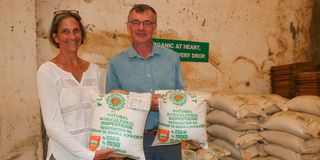
Ian Shaw, Director Kapi Limited, with his spouse, Pepe Shaw, display some of the organic biopesticides manufactured using pyrethrum at their firm in Nakuru on January 31, 2026.
The new biopesticides are broad-spectrum, targeting a range of pests in a single application.
“The goal is to help farmers manage pests in a way that limits repeated treatments and reduces overall chemical use,” he notes.
The products are sold in a variety of sizes, ranging from 50ml to one litre, and are stocked in over 1,500 agrovet stores nationwide, ensuring they are easily accessible to smallholder farmers.
Recent investigations have highlighted the risks posed by banned and highly toxic pesticides entering Kenya through informal channels. Farmers, who produce most of the country's food, often lack access to formal training or extension services.
Misuse during mixing, spraying or harvesting can cause illness, contaminate crops and result in residues reaching urban markets and posing health risks for consumers.
The challenge has intensified over time. In 2025, the Kenyan government banned 77 hazardous pesticide products and restricted the use of a further 202, highlighting the dangers posed by unsafe chemicals in agriculture.
This left many farmers, who were already struggling to access reliable resources, with fewer options for pest control.
Studies on adoption suggest that biopesticides can be as effective as conventional chemical pesticides in managing pests affecting high-value crops such as tomatoes, avocados and flowers when applied correctly.
"The aim is to provide alternatives that reduce reliance on hazardous chemicals and improve the predictability of pest control by combining safer products with practical instruction," he says.
This approach considers the realities of farming in Kenya, where resources are limited and access to technical support is uneven.

An employee at Kapi Limited brands liquid organic biopesticides manufactured using pyrethrum by the firm located in industrial area, Nakuru City on January 31, 2026.
In areas where informal pest control methods and banned chemicals are sometimes employed, providing training and guidance on safer methods can help to ensure more consistent pest management and reduce health risks.
“Sustainability begins with the people growing the crops. If farmers are not supported with knowledge and resources, nothing else matters,” he says.
The introduction of ready-to-use biopesticides forms part of the wider practice of integrated pest management (IPM), which uses biological, cultural and chemical methods to manage pests in a sustainable way.
"We provide farmers with access to biopesticide products and invest in guidance and demonstrations. This helps them understand how these products can be incorporated into pest management practices on their farms," he adds.