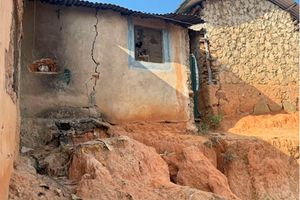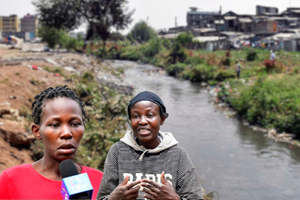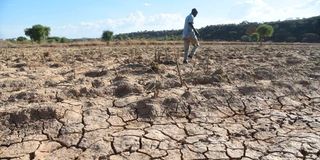
Charles Bungei shows where his farm is at Loruk in Tiaty, Baringo County, on September 03, 2026. The farm was submerged when water levels in Lake Baringo rose. The water has since receded but is likely to come back with El Niño rainfall.

“El Niño is not synonymous with rain.”
That was the first thing Dr Joyce Kimutai wanted to get out of the way when she appeared on NTV’s “Fixing the Nation” early this week. And she had a good reason to.
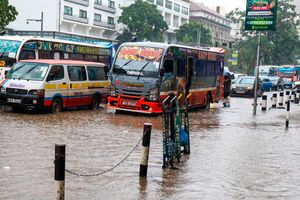
In Kenya, say “El Niño”, and you do not have to explain what you mean. The word itself conjures rain: flooded roads, swollen rivers, dark skies and days of heavy downpours. But this image captures only one part of El Niño, leaving much of the phenomenon out of the picture.
Money, for instance. The 2023/2024 El Niño-induced heavy rains cost Kenya an estimated Sh187.8 billion in damage and losses.
That is more than twice what it cost to build the Nairobi Expressway, which was put at about Sh87.9 billion. In other words, the losses from a single climate event were enough to build two Nairobi Expressways and still leave billions of shillings over.
“El Niño is just a natural event that happens in the Pacific Ocean. But what manifests, or the impacts of that weather or that change in the Pacific Ocean, is what can be rain in some parts and droughts in other parts,” she said.
Let’s dive a little bit deeper.
“What happens is that there is an accumulation of heat in the Pacific Ocean and what happens is that there are winds that normally blow above it. During El Niño, those winds relax and when they do, there’s little movement in the ocean. So, there’s a lot of heat at the surface of the ocean. And what it does is release that heat to the atmosphere and that’s why during El Niño, some parts of the world get very hot. We’ve seen what happened in Europe and we are starting to see wildfires in places like Canada,” she explained.
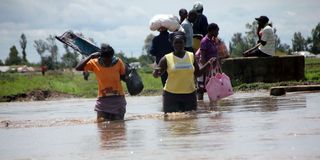
Residents of Ombeyi Village in Ahero move to safer grounds after their houses were flooded by El Nino rains on November 17, 2015.
Crop Failure
While some are still talking about El Niño as something that is coming, the conditions are already influencing weather patterns in parts of the country. In the North Rift and parts of Western Kenya, farmers are counting losses after crop failure, with Dr Kimutai attributing the depressed rainfall in the regions to the prevailing El Niño conditions.
“As we are going into the October-November-December (OND) season, we are expecting above-normal rainfall, so we are likely to see saturated soils in most parts of the country and this is really beneficial for farming in stable areas. However, it can be very dangerous for mountainous regions and have escarpments.”
One question many Kenyans were asking last month was why August felt unusually cold in parts of the country. As some of you were heaping on layers of clothing, people in parts of Asia and Europe were facing a very different reality, with harrowing accounts of extreme heat.
The contrast came against a backdrop of a planet that was itself experiencing exceptional heat.
The Copernicus Climate Change Service said on Thursday that August was the joint-hottest August on record, pushing the planet’s average global temperature to more than 1.5 degrees Celsius above pre-industrial levels. It attributed the record heat mainly to global warming driven by the burning of coal, oil and gas, alongside rising temperatures in the Pacific as a “very strong” El Niño continues to strengthen.
“El Niño alters the temperature and precipitation patterns across the whole world. It is associated with warmer-than-average temperatures in Kenya. What the warmer-than-average temperatures mean is that the OND temperatures will be warmer than what we are used to. We will still experience cold days, especially when it will be raining, but on average the temperature will be warmer than usual,” explained Hannah Kimani, assistant director, public weather services at Kenya Meteorological Service Authority (KMSA).
Food basket
The World Meteorological Organisation has said that the El Niño conditions will persist through February 2027.
“El Niño is being supersized before our eyes. The science leaves no room for doubt: the planet is in uncharted waters, and those waters are heating up. Sea surface temperatures are rising, temperatures keep climbing, and the world is in the danger zone of extreme weather. The race now is between rising risks and our commitment to take climate action and protect people. We must win that race,” said UN Secretary-General António Guterres.
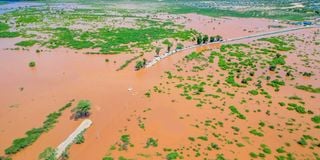
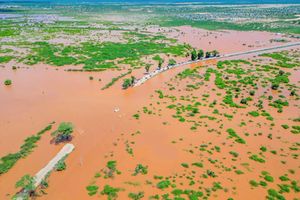
An aerial photo of flooded roads along the Garissa-Mombasa road in Tana River County taken earlier during the el-nino floods in October 2023.
While the rain will eventually stop, experts stress that the consequences will not necessarily stop with it. From health risks to food crisis.
For farmers, as agricultural expert Amos Kimutai said, can disrupt the delicate timing of planting, growing and harvesting. Too much rain can flood fields and destroy crops, while dry spells at critical stages can leave farmers with little to harvest.
“A failed harvest means lost income for farmers, less food entering the market and potentially higher prices for consumers. And even when the El Niño conditions fade, the farmer still has to live with what was lost, sometimes until the next planting season.”
Follow ourWhatsApp channel for breaking news updates and more stories like this.