The ongoing high-profile meetings and consensus-building efforts by the opposition point to the principals’ resolve to translate their common interest in challenging President William Ruto into a united front.
With the polls barely 10 months away, the opposition has been jolted into confronting competing interests as it seeks to settle on a single presidential candidate.
The question of when to name the presidential candidate, settling on a running mate, addressing regional dynamics and responding to the demands of Gen Z are some of the challenges that will require further talks ahead of the August 10, 2027 polls.
Top figures in the opposition are already racing against time to build consensus on the most agreeable formula for picking the presidential ticket without fragmenting the formation or upsetting its major voting blocs.
Although the opposition continues to face competing ambitions that threaten its unity, its top leaders have committed to producing a single candidate to face Dr Ruto.
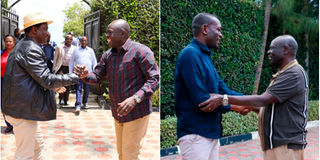
“We are relentless in our pursuit of unity,” Wiper Patriotic Front leader Kalonzo Musyoka said on Monday after being hosted by Democracy for the Citizens Party (DCP) leader Rigathi Gachagua at his Wamunyoro home in Nyeri.
Similar remarks were made by Mr Gachagua, who said the opposition’s only chance to beat Dr Ruto was to rally behind a single candidate.
“We are in agreement that the identification of a single presidential candidate is the surest path to winning next year’s General Election, and we are all fully committed to that goal,” said Mr Gachagua.
The former deputy president added: “We are all in agreement that we shall make whatever sacrifices necessary to settle on one presidential candidate to be the captain of our struggle.”
DCP leader Rigathi Gachagua and his wife Pastor Dorcas Rigathi welcome Wiper Party leader Kalonzo Musyoka at their Wamunyoro home in Nyeri County on October 26, 2026.
Photo credit: Mwangi Muiruri | Nation Media Group
Agreeing on who should face Dr Ruto remains the camp’s major challenge since most of its top leaders have national ambitions. There are fears that the competing ambitions could undermine their collective strength.
The principals are already grappling with the question of who has the strongest national appeal and who can attract backing from across the regions.
A July survey by Trends and Insights For Africa (Tifa) revealed that Nairobi Senator Edwin Sifuna’s support, should he vie for the presidency, had risen to 15 per cent within months of hinting at the possibility of challenging President Ruto.
The figure made him the closest challenger to the Head of State, whose support stood at 24 per cent, having stagnated at that level.
Mr Sifuna was ahead of other political bigwigs including Mr Gachagua (7 per cent), Mr Musyoka (13 per cent) and former Interior Cabinet Secretary Fred Matiang’i (14 per cent).
Other parameters for consideration include which of the principals has the financial resources and political machinery to mount a successful presidential campaign.
DCP party Leader Rigathi Gachagua (right) welcomes Linda Mwananchi Party leader Edwin Sifuna to his Wamunyoro residence.
Photo credit: Pool
Regional arithmetic is also emerging as a major consideration. Kenya’s elections are heavily influenced by regional voting patterns. Mount Kenya, for instance, has become a major voting bloc due to its numerical strength. The region was crucial to Dr Ruto’s election in 2022.
To address regional arithmetic, presidential candidates often use the running mate slot to balance regional interests. In the opposition, there are talks on how to pair the ticket, with an East-West combination gaining some traction. A combination of Mr Musyoka and Mr Sifuna remains the most favoured ticket, according to recent surveys.
The choice of a running mate is therefore crucial in averting divisions within a formation. The running mate slot is significant for balancing regional interests and attracting additional votes, especially if the nominee has a strong support base.
The opposition is also grappling with the place of Gen Z. Analysts believe that young people may not be comfortable with politicians who have held senior positions in the past as they push for a fresh start.
Kitui Senator Enoch Wambua says the opposition needs to pick its candidate early enough to allow for resource mobilisation.
“For me, the naming of the opposition joint presidential candidate is long overdue. A presidential candidate needs time to build national and international networks, mobilise resources and put structures in place in preparation for good stewardship of the country,” says Mr Wambua, a close ally of Mr Musyoka.
He says Kenyans need to know the person who will face Dr Ruto early enough, suggesting that this should happen before the rollout of the next mass voter registration.
“Kenyans need to know who will be facing Ruto on the ballot. That person cannot be ‘one of us’. I gather that there is near consensus that the opposition will give Kenyans a Christmas gift by naming a candidate before the end of the year,” he told the Nation .
Jubilee Party deputy party leader Jeremiah Kioni says some opposition principals are great political mobilisers but cannot be trusted with the leadership of the country.
Former Deputy President and Democracy for the Citizens Party (DCP) leader Rigathi Gachagua hosts Wiper Democratic Front leader Kalonzo Musyoka at his Wamunyoro home in Nyeri County on October 26, 2026.
Photo credit: Pool
“There are so many issues to be addressed. Some people have the ability to make the country move forward, but lack the ability to mobilise votes. Others have the ability to mobilise votes, but Kenyans can’t trust them to lead,” says Mr Kioni.
The opposition is also facing regional supremacy battles as leaders seek to position their parties as the dominant players in their regions.
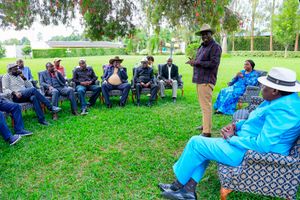
In Western, Mr Sifuna and Democratic Action Party-Kenya (DAP-K) leader Eugene Wamalwa are perceived to be engaged in a battle for regional supremacy. Mr Wamalwa, accompanied by elders, visited Mr Gachagua on Monday, days after Mr Sifuna led the Linda Mwananchi Movement brigade for a similar engagement.
Top DAP-K leaders from the region have thrown their weight behind Mr Sifuna. Trans Nzoia Governor George Natembeya, former Tongaren MP and DAP-K secretary-general Eseli Simiyu, and Wafula Wamunyinyi have ditched the party led by Mr Wamalwa in support of Mr Sifuna.
In Mount Kenya, DCP is flexing its muscles against Jubilee, led by former President Uhuru Kenyatta; the People’s Party of Kenya (PPK), led by Kiharu MP Ndindi Nyoro; and Martha Karua’s People’s Liberation Party (PLP).
DCP Secretary-General designate John Methu said on Monday that the opposition would vet new parties seeking to join the coalition. He claimed some parties could be used to cause divisions within the opposition.
“We will also continue to seek others committed to the Wantam (one term) movement because there are some who are chanting Wantam out there but are not real. We want to partner with like-minded individuals who believe that it is anybody else and not Dr Ruto. Those are the kind of people we will work with,” Mr Methu said.
Some of the fights within the opposition are regional supremacy battles, with leaders seeking to establish their authority.
At the heart of the fight is the desire of individual parties to secure a majority of elective seats and gain control of the region, which has traditionally held major sway in national politics.
Democracy for the Citizens Party (DCP) leader Rigathi Gachagua(right), Nairobi Senator Edwin Sifuna and DCP Secretary-General designate John Methu in Wamunyoro.
Photo credit: Pool
Democratic Party leader Justin Muturi told the Nation that the opposition is aware of the challenges it faces in picking a candidate. He noted that its unifying factor is the desire to defeat Dr Ruto.
“Coalition building is never easy anywhere and we don’t expect it to be a walk in the park here in Kenya. We remain committed and ready to surmount whatever challenges lie ahead,” said Mr Muturi.
He added: “The unifying factor is the desire to remove Ruto from office and restore constitutional order, good governance and the rule of law. Of course, we want to remove him democratically through the ballot.”
Mr Wamalwa on Monday likened his visit to Wamunyoro to a similar engagement between his late brother Wamalwa Kijana and Narc leader Charity Ngilu, when they visited Mwai Kibaki in the run-up to the 2002 polls.
“It reminds us that coalition building is not a one-off event but a process of continuous consultations and negotiations. May the Almighty God grant us the grace, patience and sacrifice of 2001/2002 that made us succeed then, so that we may succeed in our endeavours now,” said Mr Wamalwa, referring to the Narc coalition that propelled Mr Kibaki to victory over retiring President Daniel Moi’s Kanu candidate, Uhuru Kenyatta.
A draft coalition working framework has highlighted key electoral timelines to watch amid pressure on the principals to address the major sticking points.
The document, which is yet to be adopted by the principals, indicates plans to deposit the opposition coalition agreement with the Office of the Registrar of Political Parties (ORPP) by March 31, 2027.
Filing of the agreement is set to precede a power-sharing deal, which the coalition projects to conclude by the last week of March 2027. The document describes it as “leadership package designations”.
According to the draft obtained by the Nation, the coalition is also considering zoning the country to allow partner parties to field candidates in areas where they are more popular and have a chance of winning seats for the broader formation.
The document has set the end of February 2027 as the deadline for the “final map of zoned seats”. The key dates are aligned with major electoral timelines set by the Independent Electoral and Boundaries Commission (IEBC).
Mr Gachagua has, however, publicly rejected zoning. At a previous event, he said only the presidency should be spared from competition.
Zoning is a political arrangement in which parties in a coalition agree not to field candidates in each other’s strongholds. The arrangement has, however, remained contentious in previous elections.
Former Prime Minister Raila Odinga was forced in 2022 to abandon the plan after fringe parties threatened to ditch the Azimio La Umoja One Kenya Coalition over its opposition to giving way to “popular” parties.