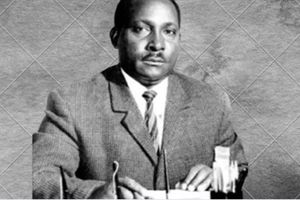
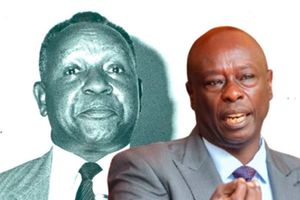
When John Karuga Koinange rose in the Senate on September 19, 1963, he demanded the removal from Parliament Buildings of all “imperialist relics, including the bust of General Smuts and all testimonials extolling the massacre of Africans during the Emergency.”
Koinange’s motion appeared to confirm what many expected independence to involve: a nationalist government cleansing public spaces of monuments celebrating British conquest, settler power and colonial violence. It is still widely assumed that Jomo Kenyatta’s government initiated the removal of Kenya’s most conspicuous colonial statues.
Archival records, however, tell a more complicated story. Long before Koinange presented his motion, British officials were quietly considering which monuments should disappear before independence. Their concern was not historical justice or the pain such monuments caused Africans.
It was the possibility that statues would be attacked, defaced or dramatically pulled down during the Uhuru celebrations.
The colonial government wanted to manage the retreat of its symbols before Africans did it for them. If the statues had to fall, the British intended to determine when, how and where they fell.
Ten days before Koinange’s motion, Governor Malcolm MacDonald had written to Kenyatta, then Prime Minister, reminding him of “a conversation which we had on the question of certain statues and memorials in Kenya.”
The matter had first been raised with the Governor by a delegation from the Kenya National Farmers Union. It then became the subject of internal discussion within the colonial administration. London was consulted, provincial officials were asked to assess the danger, and an inventory of potentially vulnerable monuments was prepared.
The Deputy Governor proposed a distinction between memorials that could safely remain and statues that might provoke nationalist anger. War memorials, he suggested, “should stay.” So should “other visually impersonal memorials such as fountains and memorial gardens.”
“It is statues that are potentially vulnerable,” he warned.
That distinction revealed the political calculation behind the exercise. Colonial officials were not proposing to erase every physical trace of British rule. They were principally worried about monuments representing identifiable personalities: monarchs, imperial adventurers and settler grandees whose bronze and stone likenesses embodied the racial hierarchy that independence was overturning.
A fountain could be presented as part of the city’s heritage. A statue of a monarch or settler leader was harder to neutralise, because it asserted authority over the landscape and reminded Africans who had conquered, governed and appropriated their country.
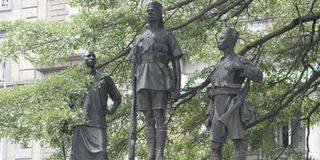
The War Memorial Monument along Kenyatta Avenue in Nairobi.
Photo credit: Lucy Wanjiru | Nation Media Group
MacDonald reminded Kenyatta of their understanding: “You remember we agreed that we should do what we could to avoid any undesirable incidents at the time of or after independence, and that I should prepare a list of statues which might be the subject of ill feeling by local people, and which should perhaps, therefore, be removed.”
What Kenyatta may not initially have known was that MacDonald had already commissioned a study of the monuments. An aide-memoire had been prepared identifying those considered politically vulnerable.
“I think I must put it to the PM to make sure he agrees,” MacDonald told the Deputy Governor long before they reached out to Kenyatta.
The initiative, therefore, did not originate with Kenyatta as widely thought. It arose from British anxiety about what might happen to the symbols of empire once Britain surrendered political authority. Kenyatta was consulted because his approval would legitimise the operation and help prevent the removal of the statues from becoming a nationalist victory over departing colonial power.
The administration in Nairobi had already asked London for guidance. On June 6, 1963, it wrote to the Colonial Office seeking information on what had happened to statues in other territories at independence.
In a reply dated August 2, Under-Secretary P.J. Kitcatt admitted that officials had failed to find useful precedents.
“We have gone through this matter with our customary diligence but we have failed completely to disinter any precedents that might be useful,” he wrote.
“Like you, we have heard about the statue of General Gordon—and that of De Lesseps—but we cannot find any other similar examples, and we have concluded that in other colonial territories any statues or other monuments were left in place on independence.”
Kitcatt added, with revealing unease: “Perhaps we hear only of those which suffered an unpleasant fate!”
And with that, Nairobi was left to decide. The absence of an imperial policy exposed the novelty of the problem, and how the Mau Mau memory was complicating matters. Britain had extensive experience lowering flags, playing anthems and transferring constitutional authority. It had devoted much less thought to what should happen to the personalities it had cast in bronze and placed at the commanding points of colonial cities.
These statues, as we all know, were not merely decorations. They were territorial claims and placed empire in the everyday landscape and made colonial power appear permanent. Their destruction during Uhuru would have turned independence into more than a constitutional ceremony. It would have produced a powerful public spectacle of Africans physically overthrowing the old order.
The Deputy Governor recommended that nothing should be done about the long list of impersonal plaques, fountains, gardens and war memorials. Most likely, they would have shown panic or retreat. These were objects about which, he said, “I feel we cannot, and should not, do anything.”
The anxiety centred on personal memorials, beginning with representations of British monarchs. Nairobi had the statue of Queen Victoria in Jeevanjee Gardens and the King George VI memorial on Connaught Road—today’s Parliament Road—which incorporated a bust of the late monarch. There was also the statue of King George V outside the High Court, at the site where the Jomo Kenyatta statue stands today.
The initial recommendation was that the royal monuments should remain, for there appeared to be no practical alternative (and no precedent).
“Her Majesty’s Government are not interested and there are neither means nor money with which to remove them, nor any appropriate alternative resting place,” the memorandum observed. “And I doubt if they will suffer desecration, though in due course the independent Kenya government may wish to remove them.”
Ownership further complicated the matter. The Queen Victoria statue belonged to the Nairobi City Council and had been presented by Mr Jeevanjee and unveiled by the Duke of Connaught in 1906. Colonial officials could not simply remove every monument by administrative order.
They had to consider ownership, transportation, expense and possible resting places.
Mau Mau monument that stands at Freedom Corner in Uhuru Park, Nairobi in honour of Mau Mau war victims.
Photo credit: Lucy Wanjiru | Nation Media Group
F.A. Loyd, the Permanent Secretary in the Governor’s Office, similarly suggested on August 10 that nothing should be done about the Vasco da Gama memorial at Malindi. He sought advice on the Krapf memorial and reported that arrangements were already in progress concerning the Candler memorial at Taveta. Candler was the Kangema District Officer killed by Mau Mau.
The only alternative, MacDonald deputy wrote, was to raise the matter directly with Kenyatta and ask whether he believed the statues should be removed.
“I feel it is unlikely that anything will be done to any of them in the foreseeable future which could cause widespread offence,” he wrote. “Certainly, the Prime Minister has given every indication so far that any such hooliganism would be deprecated by himself.”
The Delamere family, however, was unwilling to leave its most conspicuous monument to chance. Arrangements were made to remove the Delamere statue from the junction of Delamere Avenue and Hardinge Street—now Kimathi Street—and take it to the Sorsbie Gallery. It was later transferred to Soysambu in Naivasha.
The Governor was informed that Tom Delamere had discussed the matter with Kenyatta. The Prime Minister had confirmed that Delamere Avenue would be renamed, providing “a ready-made pretext and occasion for removing the statue from the place of honour, so to speak, in the present Delamere Avenue.”
The family was satisfied with the arrangement of renaming the avenue for it saved them from the humiliation of the statue being pulled down.
Later, MacDonald discussed the broader question with Mzee Kenyatta (on removal) on June 19. According to the Governor, Kenyatta “welcomed my suggestions and was obviously very touched and grateful that we should understand the Africans’ sensitivity on this sort of matter.”
Kenyatta agreed that it would be “deplorable if some wild enthusiast at the time of Uhuru defaced one of the statues or monuments that we have in mind.”
MacDonald reported that the proposed action would prevent such an incident and preserve “that very friendly goodwill between the different racial communities in Kenya which is essential for Kenya’s peace and progress.”
This exchange is crucial. Kenyatta accepted the proposed removals, but the records do not portray him as the architect of a systematic purge.
His concern, like MacDonald’s, was an orderly transition and the avoidance of racial confrontation.
Their reasons, however, were not identical. For Africans, the statues embodied conquest, dispossession and humiliation. For the British, their destruction would constitute a final and globally visible repudiation of empire. A crowd pulling down a monarch or settler hero would claim ownership of independence in a way that official ceremonies could not control.
Koinange’s Senate motion demonstrated that pressure for a more complete symbolic decolonisation existed. His demand to remove General Smuts and testimonials celebrating the Emergency showed that African politicians did not regard such objects as harmless remnants of history. Inside Parliament Buildings, they proclaimed whose lives deserved honour and whose deaths colonial power considered worthy of celebration.
Ultimately, the statues of Delamere and the monarchs came down, but others survived. The Galton Fenzi memorial remains at the junction of Koinange Street and Kenyatta Avenue. The Muthaiga War Memorial remained at the junction of Thika and Kiambu roads until construction of the superhighway, when it was moved inside the Muthaiga Country Club.
This uneven survival shows that there was no wholesale cleansing of Kenya’s colonial landscape. The British retreat was selective and strategic. Officials considered removing monuments partly to prevent disorder, partly to protect them from destruction and partly to deny African nationalists the spectacle of pulling them down. By acting first, the colonial state transformed a potentially dramatic repudiation of empire into a controlled administrative exercise.
What appeared afterwards to be a Kenyatta-led purge had begun as an exercise in British anticipatory fear. It was decolonisation managed from above: sufficient to prevent confrontation, but carefully controlled to protect colonial dignity.
The statues fell, but the British made sure they fell on British terms.
John Kamau is a PhD candidate in History, University of Toronto. Email: [email protected]