Former Meru governor Kiraitu Murungi may be serving in government as the chair of the Competition Authority, but he has chosen to candidly write about President William Ruto’s achievements.
In his book Illusions of Democracy: A Political Memoir that is set to be launched on Friday, he examines the impact of the “hustler versus dynasty” politics propagated by President William Ruto as he campaigned for the presidency in 2022 and the impact they had on the political landscape.
At a personal level, he believes that the fact that he himself was branded a “dynasty” against a newer entrant in politics saw him lose his governorship seat. At the national level, he argues that the politics caused a dynamic shift and also led to deep post-election disillusionment.
The “hustler versus dynasty” framing, he argues, turned material frustration into a moral choice between ordinary people and an allegedly distant elite.
An analysis by the French Institute of International Relations found that Ruto’s “hustler” narrative placed the economy and vulnerable voters at the centre of the contest while portraying his opponents as an old, dynastic elite removed from ordinary struggles.
“For the first time in Kenya’s history, class became the dominant mode of political mobilisation,” writes Mr Murungi.
However, Mr Murungi feels that after Dr Ruto won the presidency in the August 2022 polls, the messaging would come back to bite him as fiscal constraints, debt and institutional weaknesses reared their ugly head.
“Ruto has projected himself as a visionary transformational leader with a dream of turning Kenya into Singapore. He has embarked on ambitious projects in infrastructure, housing, health, and youth economic empowerment, but he is yet to fulfil his extravagant promises: poverty alleviation, universal healthcare, housing, free education, rule of law, and empowerment of mama mboga and boda boda operators,” argues Mr Murungi.
“Various reports of mega corruption and dysfunctional health and education systems, and ghost services, have caused a general sense of cynicism, resentment and widespread discontent among Kenyans, especially the youth,” he adds.
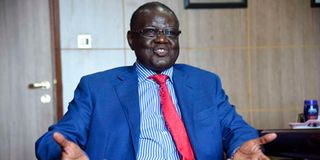
Former Meru Governor Kiraitu Murungi during a past interview at his Nairobi office on November 30, 2021.
Photo credit: Evans Habil | Nation Media Group
The youth-led protests in 2024, he says, were a product of disillusionment. Through them, a government elected on the strength of the hustler message now faced protests led by many of the young and economically pressured citizens to whom that message had appealed.
The “hustler-dynasty” divide, Mr Murungi notes, was also a key factor in the failure of the Azimio la Umoja One Kenya Coalition Party to win over the Mt Kenya region and to mobilise locals to vote for the coalition’s candidate, the late Raila Odinga .
He further notes that the alliance entered the contest burdened by grassroots hostility, weak organisation and a failure to read the public mood in Mt Kenya.
Through the “hustlers-dynasty” messaging, Mr Murungi writes, Dr Ruto rallied the politicians who had become disillusioned with then then-President Uhuru Kenyatta .
The former governor says resentment against Mr Kenyatta had already taken hold in Mt Kenya East. Residents who had voted overwhelmingly for him felt abandoned during his final term, he writes, citing infrequent presidential visits, stalled projects and the exclusion of Embu, Meru and Tharaka-Nithi from the 500-kilometre Mau Mau roads programme. The sense of rejection, he says, turned affection for the President into anger.
“A deep ‘jilted lover complex’ developed against him,” he writes.
“I was part of the collateral damage of a strong wave of antipathy against [Mr Kenyatta],” he adds, noting that the then president had been friendly and informal to Mt Kenya residents in the 2013 and 2017 campaigns. “After he won his final term, he became cold, distant, and insensitive to them.”
'Railaphobia' in Mt Kenya
That mood gave Dr Ruto a decisive opening against the late Raila Odinga, who was running on the Azimio coalition that included Jubilee Party.
Mr Murungi says an opinion poll he commissioned showed Dr Ruto enjoying more than 70 per cent support in all nine Meru constituencies.
Then seeking to defend his governorship seat, he considered crossing over to Dr Ruto’s United Democratic Alliance (UDA). He held talks with Prof Kithure Kindiki and Mithika Linturi, who urged him to cross over. But his attendance at the Sagana III meeting associated him firmly with Mr Kenyatta’s side, and UDA went on to field Mr Linturi for governor.
“It was a mistake to join the Azimio One Kenya Coalition Party,” he writes. “It was a shell without grassroots presence or effective campaign structures.”
By the time he made his choice, Mr Murungi says, the campaign in Meru was pegged on whether one was with or against Dr Ruto, arguing that his development record, policy proposals and experience in the first term as a governor ceased to matter.
Furthermore, crowds asked why he was bringing Mr Odinga to them and warned him not to mention the Azimio candidate at meetings.
“The election was reduced to a single issue, Ruto,” he recalls. “It did not matter who you were, the schools you attended, what your development record was, your morality, or what you stood for. If you were not with Ruto, your goose was cooked. Ruto had become a religion.”
The wider Azimio campaign, he argues, was also fighting deeply rooted prejudice against Mr Odinga. In Mt Kenya, campaigns revolved around what the late vice president Michael Wamalwa called “Railaphobia”, with historical hostility and propaganda overwhelming logic.
Mr Murungi says some villagers believed claims that Mr Odinga was an atheist or witchdoctor, illustrating how emotion, rather than policy, shaped the contest.
Mr Kenyatta’s own political style compounded the problem. According to the memoir, he became distant after securing his second term, rarely visited the region and was difficult even for MPs to access.
By contrast, Dr Ruto maintained a visible presence in villages. Economic hardship and drought were blamed on the administration, while residents watched the President commission projects in areas that had opposed him. Mr Murungi says supporters of Mr Kenyatta became collateral damage in a communal backlash.
Azimio funds, he claims, did not reach his Meru campaign and resources entrusted to the then Agriculture Cabinet Secretary Peter Munya were instead used to support independent gubernatorial candidate Kawira Mwangaza.
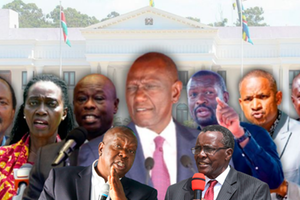
Raila Odinga with his 2022 running mate Martha Karua during their final rally at Kasarani Stadium on August 6, 2022.
Photo credit: File | Nation Media Group
Mr Kenyatta was scheduled to tour Mt Kenya but did not, and Mr Murungi says this had far-reaching consequences.
“Uhuru’s miracle political tour, which was expected to turn tables in the Mt Kenya region, did not happen. We ended up waiting for Godot. He never arrived. We were abandoned in the political battlefield. It was no wonder that we were outnumbered, outfoxed, and outperformed by Ruto,” he writes.
On the ground, the former governor says the hustler-versus-dynasty message was deeply entrenched. Wealthy and established politicians were projected as an elite indifferent to ordinary Kenyans. Mr Murungi, despite his rural upbringing and long public career, says opponents successfully branded him a “dynasty” and spread claims that he looked down on the downtrodden.
“I found out that there was a strong undercurrent created by my opponents which painted me as a ‘dynasty’. Villagers were told that rich men were only interested in our own self-interests, and we did not care about them. Rumours were spread among the mama mbogas, the boda boda operators and the small traders that I had abused them and called them chokoraa (street urchins), although this was not true,” writes Mr Murungi.
His issue-based campaign could not break through. He promoted Meru Vision 2040, the Meru Youth Service, women’s and disability programmes, boreholes, roads and agricultural projects, and promised Sh1 billion funds each for youth, women and social support.
However, he argues, voters were more interested in immediate benefits.