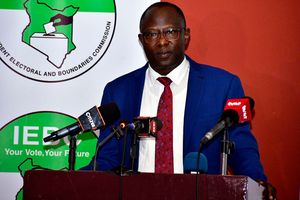
The electoral agency has moved to reorganise its county election command, transferring more than 20 senior election officials across the country as preparations for the 2027 General Election gather pace.
The transfers, contained in a circular signed by Acting Independent Electoral and Boundaries Commission (IEBC) Secretary and Chief Executive Officer Ruth Kulundu, affect county election officials who are being moved to new stations, in what the commission says is part of an ongoing administrative exercise to fill vacancies, deploy newly promoted officers and strengthen its field structure.
The changes come at a politically charged moment, with the country now firmly in the election cycle after the commission formally gazetted Tuesday, August 10, 2027, as polling day.
The commission’s official election calendar shows that preparations are already under way, with political parties facing their first major deadline on October 15, 2026, when they are required to submit the names and specimen signatures of their authorised officials.
Acting Independent Electoral and Boundaries Commission (IEBC) Secretary and Chief Executive Officer Ruth Kulundu.
Photo credit: File | Nation
But the movement of county election chiefs, coming less than a year after the IEBC was reconstituted, is likely to attract scrutiny because these officials will play an important role in administering the election at the grassroots.
IEBC Chairman Erastus Ethekon, however, sought to dispel suggestions that the transfers were linked to political considerations or concerns about the integrity of individual officers.
He described the exercise as a normal administrative routine, saying the commission had recruited new officers to replace officials who had retired, died or left the service.
According to Mr Ethekon, the recruitment of new staff and subsequent promotions had created vacancies and necessitated a fresh deployment plan.
“We have recruited new county election officials. That means the new ones now have to be reorganised and deployed to new stations,” Mr Ethekon said in an interview with Nation .
Independent Electoral and Boundaries Commission (IEBC) chairperson Erastus Edung Ethekon.
Photo credit: Wilfred Nyangaresi | Nation Media Group
He said about 17 officers had recently been recruited and promoted to positions requiring deployment to various counties.
The chairman said the commission was also dealing with vacancies created by officers who had retired or left office, explaining that some positions had remained vacant while others had been occupied in an acting capacity.
“There are people who retired. Others died and some left. So, there are about 17. We have recruited the 17,” he said.
The transfers, therefore, he argued, should not be read as a political manoeuvre or as a verdict on the performance or integrity of the affected officials.
“There is nothing really suspicious or anything to do with integrity,” Mr Ethekon said.
Among those moved are Beatrice Muli, transferred from Kiambu to Taita-Taveta; Hudson Salenoi, from Vihiga to Turkana; Rebecca Abwaku, from Homa Bay to Trans Nzoia; Reuben Mbuu, from Makueni to Kitui; and Amosi Chilai, from Nairobi to Kakamega.
Beyond the headlines, is IEBC ready for the August 2027 poll?
Others include Japheth Lagat, moved from Trans Nzoia to West Pokot; Grace Anyang, from Migori to Kericho; Husna Hassa, from Mombasa to Kilifi; Zahara Hassan, from Mandera to Wajir; and Sheikh Abdi, from Wajir to Garissa.
The list also includes Engor Emmanuel, transferred from Turkana to Narok; Frank Boinet, from Elgeyo-Marakwet to Baringo; Sidney Namulungu, from Kericho to Marsabit; John Mwangi, from Baringo to Kirinyaga; and Saumu Chirchir, from Murang’a to Bomet.
The transfers create a significant geographical reshuffle, with officers moving between counties that, in some cases, have markedly different political, demographic and logistical environments.
County election managers are part of the field machinery through which the commission coordinates election preparations, voter registration, training, logistics and polling operations.
But Mr Ethekon said deployment should not be confused with an attempt to manipulate the electoral process.
He explained that once an officer is recruited or promoted, the commission must determine where the officer will serve and fill vacancies created elsewhere.
The process, he said, is continuing.
“We are deploying them to their stations as we continue. The next level is to fill in the vacancies at the constituency level,” he said.
The chairman also indicated that more changes could follow as the commission completes its recruitment and deployment programme.
The Chairperson of the Independent Electoral and Boundaries Commission (IEBC) Erastus Edung Ethekon (left) with his deputy Fahima Araphat Abdallah and other delegates during the launch of the IEBC Strategic Plan 2024–2029 and Election Operations Plan 2025–2027 at the Kenyatta International Convention Centre (KICC) in Nairobi on June 24, 2026.
Photo credit: Wilfred Nyangaresi | Nation Media Group
This means the latest transfers may not necessarily represent the final configuration of IEBC’s county-level command ahead of the election.
The IEBC has now formally placed the August 10, 2027 election on the national calendar.
Its published election planning documents show that preparations are already spread across voter education, registration, logistics, staffing and other activities.
The timetable requires political parties to submit the names and specimen signatures of their authorised persons by October 15, 2026.
Their nomination rules must be certified by the Registrar of Political Parties by October 30 and submitted to the IEBC by November 6.
Public officers intending to contest the election will have to leave public office by February 10, 2027, while parties will subsequently be required to submit membership and primary-related information as the nomination process approaches.
Party primaries are expected to be completed before the formal candidate-registration phase, while presidential aspirants will also have to meet the constitutional requirement of collecting signatures from registered voters across a majority of counties.
Campaigns are scheduled to begin on May 29, 2027, and run until August 7, 48 hours before polling day.
The compressed timetable means the commission’s administrative machinery has to be in place well before the actual campaign period.
Mr Ethekon noted that, for the commission, therefore, the deployment of county officials is part of a much larger exercise to position personnel before the more politically charged stages of the election process begin.
The movement of election officials nonetheless puts a spotlight on the question of how IEBC intends to maintain institutional stability while preparing for a high-stakes election.
County election managers are the commission’s face on the ground and are expected to work with constituency-level officials, political parties, security agencies and other stakeholders.
Their familiarity with local geography and election infrastructure can be important, particularly in counties where logistical challenges are pronounced.
Once deployed, he said, they are expected to serve wherever the commission assigns them.
“If you are told to go to a new station, you go there and do the work. You don’t go and say you must work at one place,” he said.
The chairman said the commission would continue making deployments as recruitment and promotion processes progress.
He also indicated that further decisions on deployment would be made through the commission’s internal processes, with political parties to be informed where required by law.
Ms Kulundu became Acting CEO and Commission Secretary on August 5 following the end of Moses Ledama Sunkuli’s six-month tenure in the position.
She was appointed for two months or until a substantive office holder is recruited, whichever comes first.
That transition adds another layer to an institution racing against time to prepare for the 2027 election.
The IEBC has previously faced criticism over institutional instability, staffing gaps and election preparedness. The current leadership therefore faces the task of ensuring that administrative changes do not disrupt preparations or undermine confidence in the electoral process.
He notes that the issue is more about ensuring that every county has a properly deployed officer before the election machinery moves into its more demanding phases.
“It’s just a normal routine thing,” he said. “We are filling in the vacancies, and we’re also deploying.”